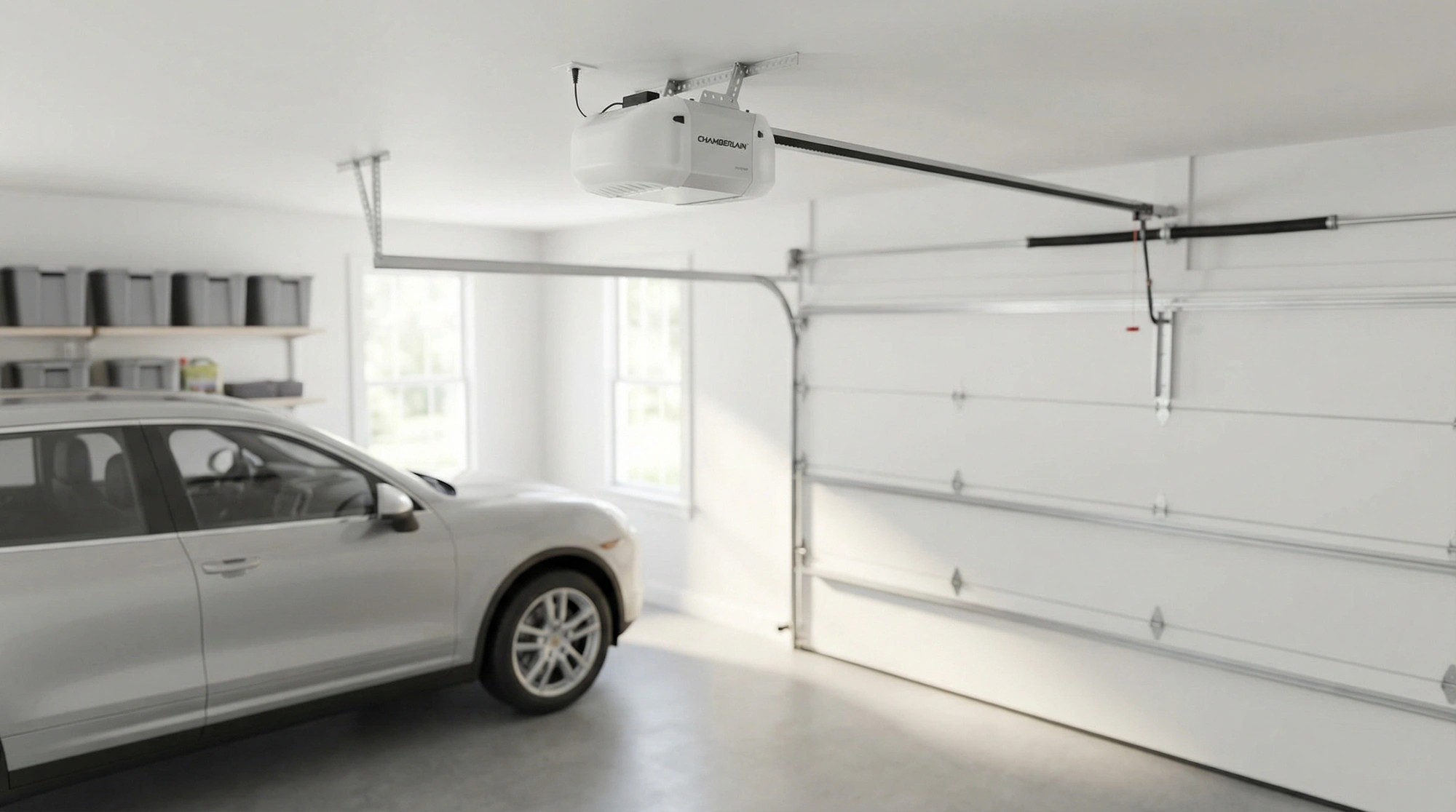
Why Your Garage Door Opener Matters More Than You Think
I replaced three garage door openers last year. Two for clients, one for myself. And in all three cases, the person had been living with a failing opener for months because they didnt think it was a big deal. The door still went up. The door still came down. Eventually.
The thing about garage door opener installation is that most people only think about it when something breaks. By then youre standing in your driveway at 7 AM trying to get to work while your door makes a sound like a cat being strangled. Not ideal.
So lets talk about what actually matters when youre picking an opener, especially if youre looking at belt drive, wall mount, or side mount options. Because theres a lot of noise out there, pun intended, and most of it is people trying to sell you features you dont need.
The Weight of What Youre Moving
Before we get into opener types, you need to understand what these things are actually doing. Your garage door is heavy. If you’re replacing the door itself, you need to know the weight because it determines what opener you need. Garage doors weigh at least 130 pounds but can be as heavy as 400-plus pounds, depending on size and material. A basic single-car steel door might be 130 pounds. A double-wide insulated wood door can push 350. Thats not nothing.
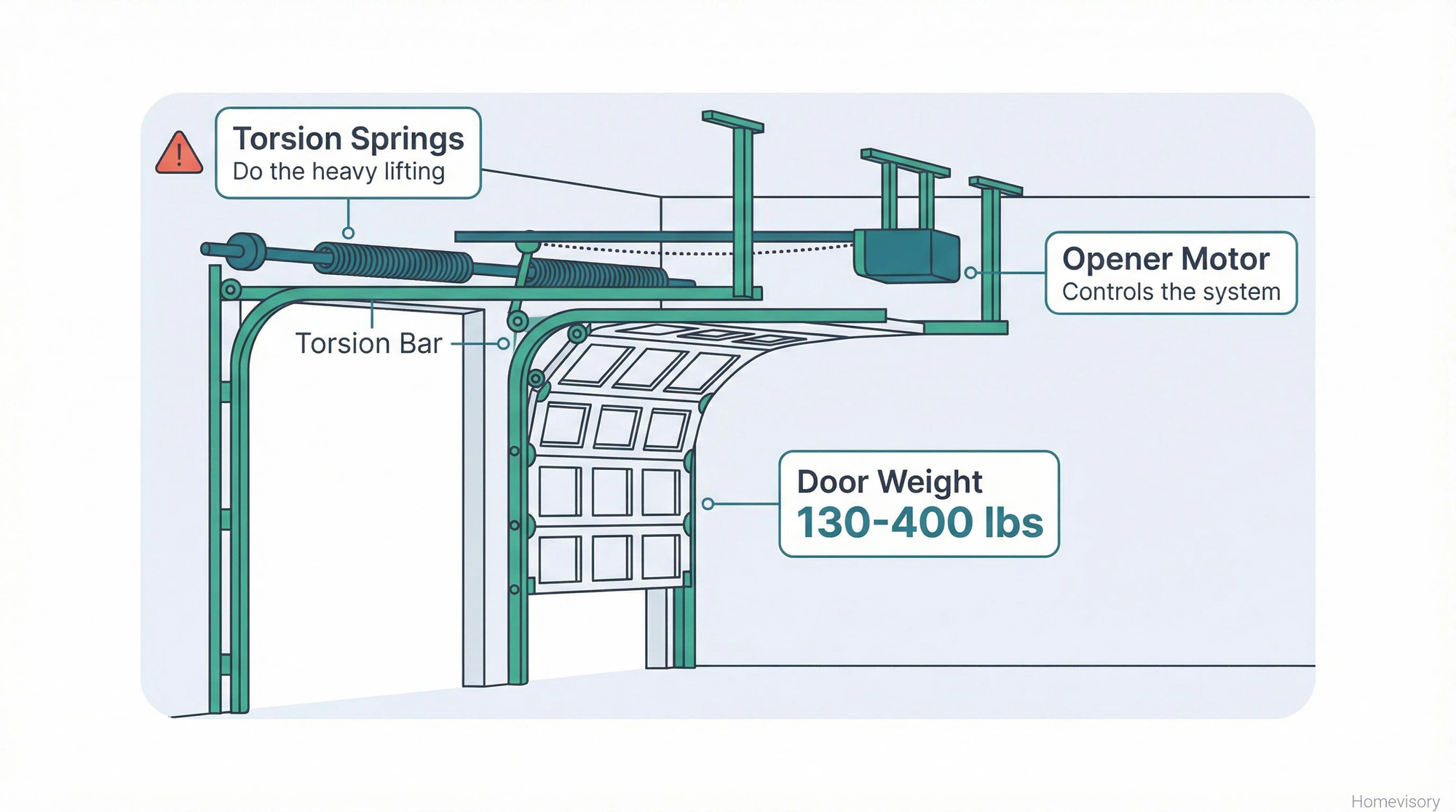
And the opener isnt really lifting all that weight. The springs do most of the work. But the opener is controlling a system under serious tension, and garage doors are typically among the heaviest moving objects in the home and are held under high tension. The springs especially. Those things can kill you. Im not being dramatic. The springs are held under extremely high tension and can snap suddenly and forcefully, causing serious or fatal injury.
So when someone tells me they want to save $50 on their garage door opener installation by going with the cheapest unit they can find, I think about those springs. I think about that weight. I think about what happens when something fails at the wrong moment.
Belt Drive vs Chain Drive
Alright. This is where I spend too much time because I care about this more than I probably should.
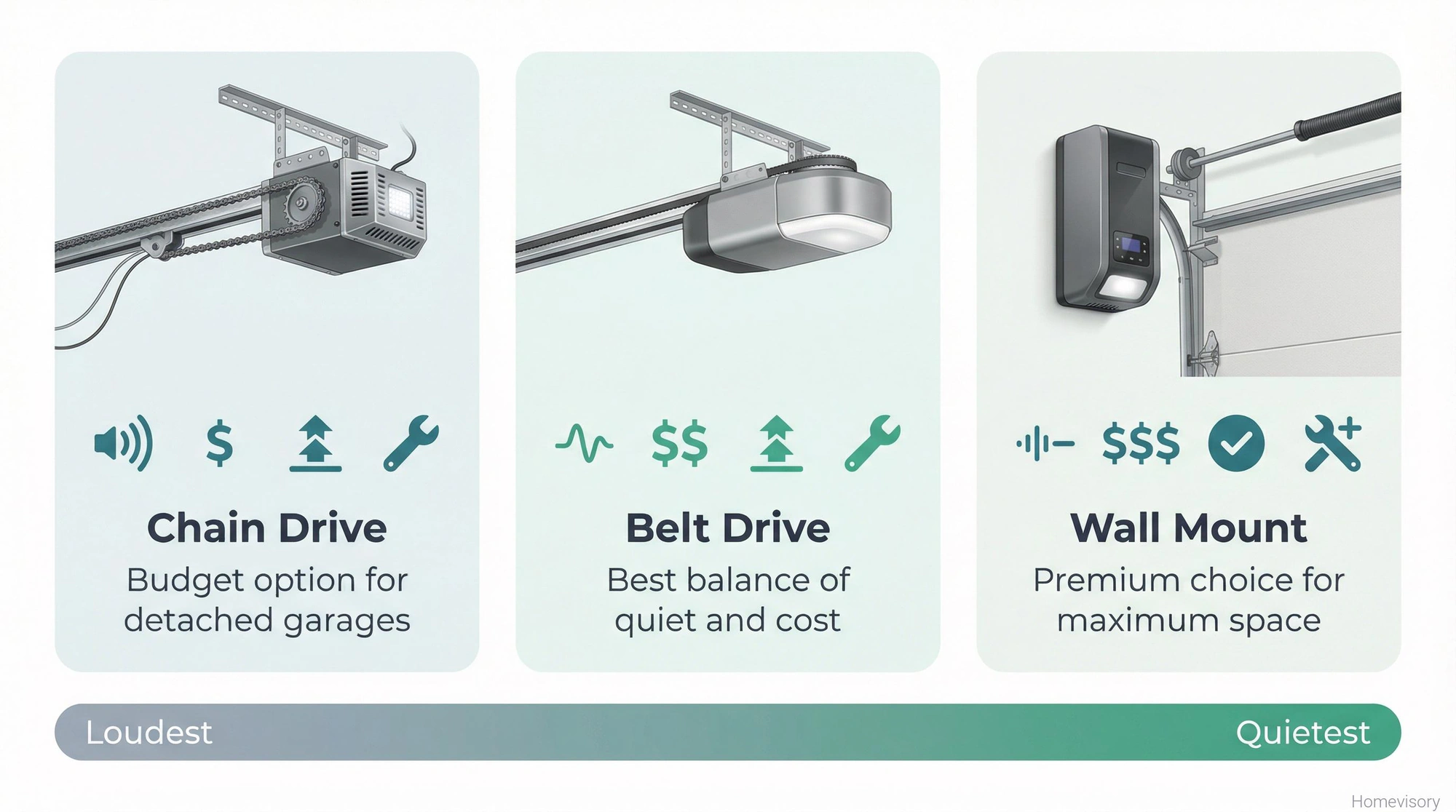
Chain drive openers are the old standard. Theyve been around forever. They work. Theyre cheap. And theyre loud.
Belt drive garage door openers use a steel-reinforced rubber belt instead of a metal chain. Belt-drive garage door openers are known for their longevity, durability, and silence. Thats the main difference. The belt absorbs vibration instead of transmitting it through your garage and into your house.
I had a neighbor in Texas, this was back in maybe 2008, and his garage was attached to his house right under the master bedroom. Every morning at 5:45 his chain drive opener would fire up and it sounded like someone dragging a shopping cart across concrete. You could hear it three houses down. My kids would wake up. I asked him once if hed ever thought about upgrading. He said it still worked fine.
It did work fine. It was just loud. And he didnt care because he was already awake.
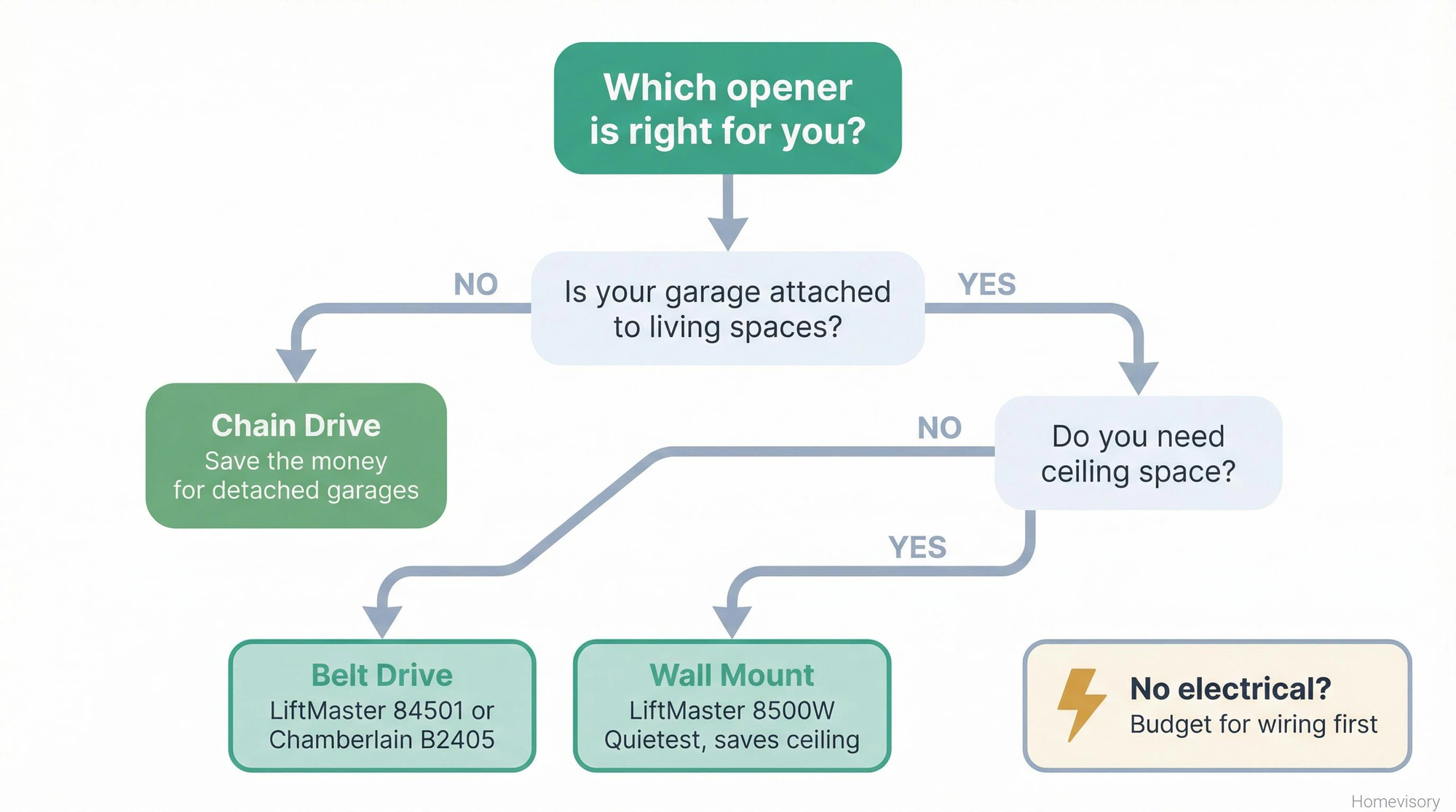
If your garage is detached, chain drive is probably fine. If its under or next to bedrooms, get the belt drive. You’ll pay maybe $75-100 more for the unit itself. Thats it. Thats the whole calculation.
Moving on.
Wall Mount and Side Mount Openers (The Jackshaft Question)
Now we get to the interesting stuff. A wall mount garage door opener, also called a side mount garage door opener or jackshaft opener, is a completely different design. Instead of hanging from the ceiling with a rail running down the middle of your garage, it mounts on the wall next to the door and connects directly to the torsion bar.
Surprisingly small and quiet, a jackshaft opener connects directly to the torsion bar above a garage door. There’s no long chain or belt, eliminating much of the noise you get with an overhead-mount opener. The motor sits right there on the wall, maybe two feet from the door, and it just turns the bar that the springs are connected to. The whole ceiling is empty. No rail. No trolley. Nothing hanging down.
Why would you want this. A few reasons.
First, ceiling space. If you have a garage with high ceilings and you want to use that space for storage, or you park a boat, or you’ve got an RV, or honestly even if you just want to put in a ceiling-mounted garage heater, having a rail running down the middle of your garage is a problem. Jackshaft eliminates that.
Second, they’re quieter than even belt drives. The motor is smaller, it’s not suspended from the ceiling where vibrations can transfer, and the mechanical action is simpler.
Third, and this is the one nobody talks about, theyre easier to service. When something goes wrong with a traditional opener, you’re climbing a ladder and reaching over your head to work on a motor that’s eight feet up. With a jackshaft, it’s right there at shoulder height on the wall.
The downside is cost. One of these openers costs about $150 more than a standard overhead door. And you need specific clearance. To install a jackshaft opener, you’ll need at least eight inches of wall space on one side of your garage door and four inches above the torsion bar. If you dont have that, it wont work.
I installed a Chamberlain wall mount in my garage in Florida three years ago. Haven’t touched it since. It just runs. Quiet. Out of the way. That’s what I want from a garage door opener. I want to forget it exists.
What Garage Door Opener Installation Actually Costs
People always ask about cost like theres one number I can give them. There isnt.
A garage door opener costs $300 to $900 on average with installation, depending on what youre putting in and whether you already have electrical in place. If youre replacing an existing opener, thats the cheaper end. If youre installing new electrical, adding reinforcement, dealing with weird ceiling heights, it goes up.
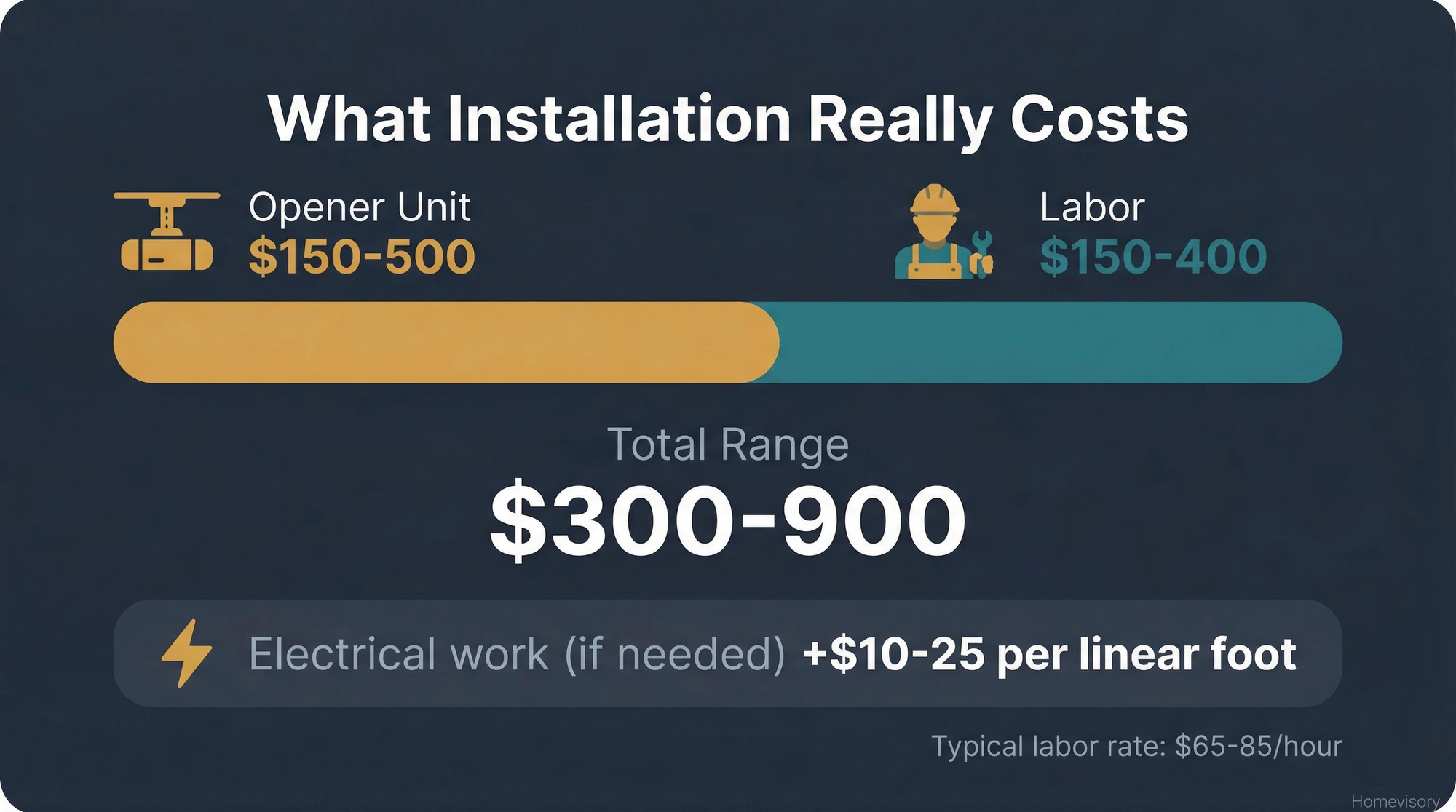
The unit itself runs between $150 to $500. Labor is typically $150 to $400. Most installers charge between $65 and $85 per hour.
If you need electrical run to your garage, thats extra. Running electricity to a garage costs $10 to $25 per linear foot.
Can you do garage door opener installation yourself. Technically yes. Overhead openers are pretty straightforward if you’re comfortable with basic electrical and can follow instructions. Jackshaft openers I’d be more careful with because youre working closer to those torsion springs, which are the most dangerous part of the whole system.
But honestly, for what installation costs, I usually tell people just pay someone. Especially if youve never done it. The time you save and the peace of mind that its done right is worth $200.
Safety Features That Actually Matter
This is the part I dont joke about.
Between 1982 and 1993, the CPSC received reports of 54 children between the ages of two and 14 who died after becoming entrapped under doors with automatic garage door openers. Fifty-four kids. That’s why the rules changed.
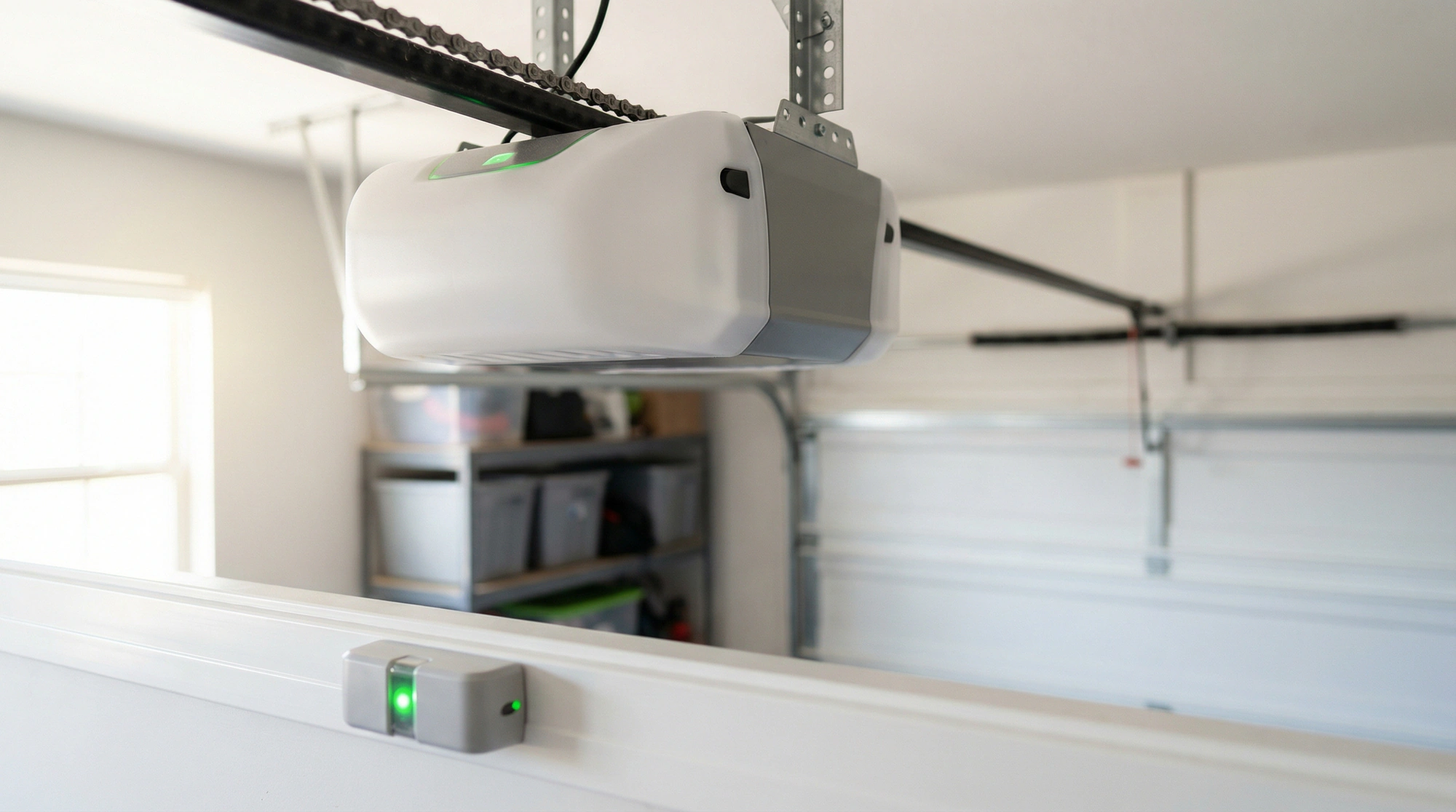
Since 1991, every residential garage door opener has to have entrapment protection. The standard requires that operators must have at least two entrapment protection mechanisms — an inherent reversal system and either an electric eye or edge sensor. The reversal system means if the door hits something while closing, it reverses. The photo eyes are those little sensors at the bottom that create an invisible beam, and if somethings in the way, the door wont close.
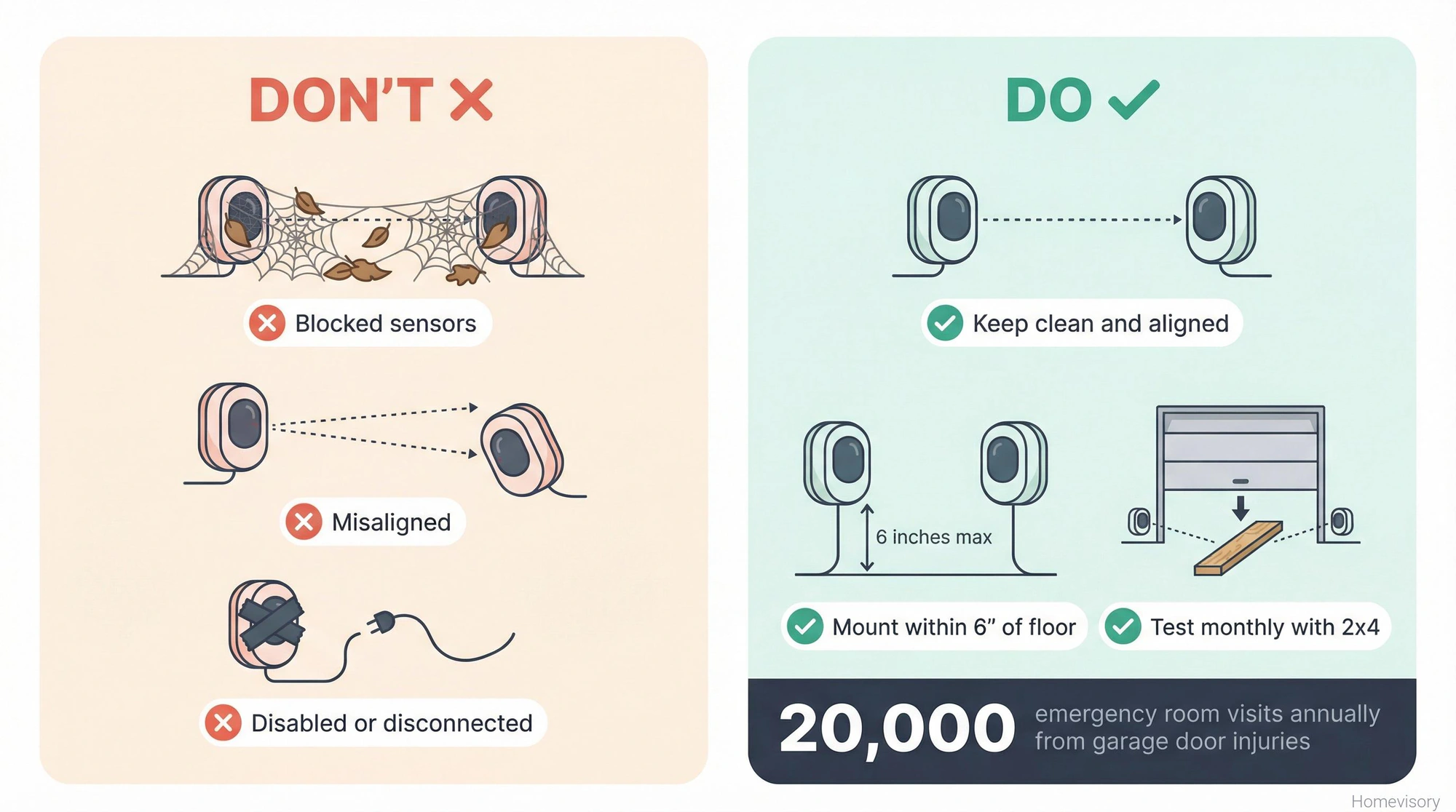
For safety reasons, photo sensors must be installed a maximum of 6 inches above the standing surface. Thats low. Low enough that a child crawling would break the beam.
I’ve seen people disable their photo eyes because they keep getting triggered by leaves or sunlight glare. Dont do that. Clean the lenses. Adjust the alignment. Replace them if theyre old. But dont disable them.
The CPSC recommends testing the reversing feature monthly. Put a 2x4 flat on the ground under the door and close it. When it hits the board, it should reverse immediately. If it doesn’t, something’s wrong.
Injuries caused by garage doors account for approximately 20,000 emergency room visits annually. Thats not all from openers. Some of that is springs, manual doors, fingers caught in sections. But the point stands. This is not a toy.
How Long Before You Replace It
A good opener should last a while. You should expect your opener to last between 10 to 15 years with average use. Average use means a couple times a day. If you open or close your garage door twice a day for a year, it adds up to 7,300 uses across 10 years.
If youre running a home business out of your garage and that doors going up and down ten times a day, adjust your expectations.
My dad Curtis had a garage door opener in Atlanta that he kept for probably twenty years. It was one of those old Sears Craftsman units from the 80s. Thing sounded like a freight train. Every time it opened, the whole garage vibrated. The chain was so stretched you could see it sagging.
He refused to replace it. Said it still worked. And it did, technically. But that opener owed him nothing by the end. It had done its job. It was time.
He used to say something about the machines at the factory where he worked, something about not fighting the machine, just let it do what its supposed to do and stop making it work harder than it has to. I think he applied that philosophy too literally to his garage door. You can let it do its job without making it do its job past the point of reason. Anyway.
The Smart Features Question
Look, modern openers come with WiFi, smartphone apps, cameras, battery backup, LED lights, all kinds of stuff. Jackshaft openers can feature all the niceties of newer overhead openers, including battery backup, WiFi connectivity, safety reversal systems, emergency cord disengagement, LED lighting and more.
Some of this is useful. Battery backup means your door still works when the power goes out. Thats actually handy in Florida during storm season. The LED lights are nice because garage lighting is usually terrible.
The phone apps. I dont know. If you want to check whether your garage is closed while youre at work, fine. With mobile apps that can now close garage doors from anywhere via phone or similar device, the standard has also been updated to require visual (flashing light) and audible (buzzer/speaker) indications to alert anyone nearby that the door is about to close. So there are safety requirements around that.
Im not getting deep into smart home integration. If thats important to you, make sure whatever opener you buy works with your system. Most major brands do. Whatever. Just do it.
What I Actually Recommend
If youre doing a new garage door opener installation or replacing an old one, here’s how I think about it:
Standard attached garage, bedrooms nearby: Belt drive overhead opener. The LiftMaster 84501 or Chamberlain B2405 are both solid. Quiet, reliable, reasonable price.
Need ceiling space or want maximum quiet: Wall mount / jackshaft garage door opener. The LiftMaster 8500W is what I have. Chamberlain makes a comparable one. Yes, its more expensive. Worth it if you have the clearance.
Detached garage, nobody cares about noise: Chain drive is fine. Save the money. Put it toward something else.
Old house with no electrical in the garage: Budget for running electrical. Its not optional. Get a quote from an electrician before you start.
You should perform routine maintenance either DIY or by hiring a professional once every year or so. Lubricate the moving parts. Test the safety features. Check that nothings loose. If your remote stops working, I’ve got a programming guide that covers every brand. Thats it.
Most people overthink this stuff. Or they underthink it and buy whatever’s cheapest at the hardware store. The middle ground is pretty simple. Buy something decent, install it correctly, maintain it occasionally, and it’ll work for fifteen years without drama. If you want the full picture on garage doors, not just openers, our complete garage door guide covers everything.
Thats what we do here at Homevisory. We help you stay on top of the stuff thats easy to forget. Your garage door opener maintenance, your filter changes, your seasonal checks. Sign up for the free Homevisory home task manager and let us remind you. Because remembering isnt the hard part. Doing it before something breaks is.