Why Your Garage Floor is Covered in Stuff
I’ve had the same conversation probably fifty times. Someone shows me their garage, half the floor is covered with boxes and bins and seasonal decorations and sports equipment, and they say “I just don’t have enough space.” Yes you do. You have a ceiling.
Most people never look up. They buy another shelving unit, squeeze it against the wall, and wonder why they still cant park their car inside. Meanwhile theres eight feet of dead space above their heads doing nothing. And if your garage door needs repair too, handle that first before you start hanging things from the ceiling.
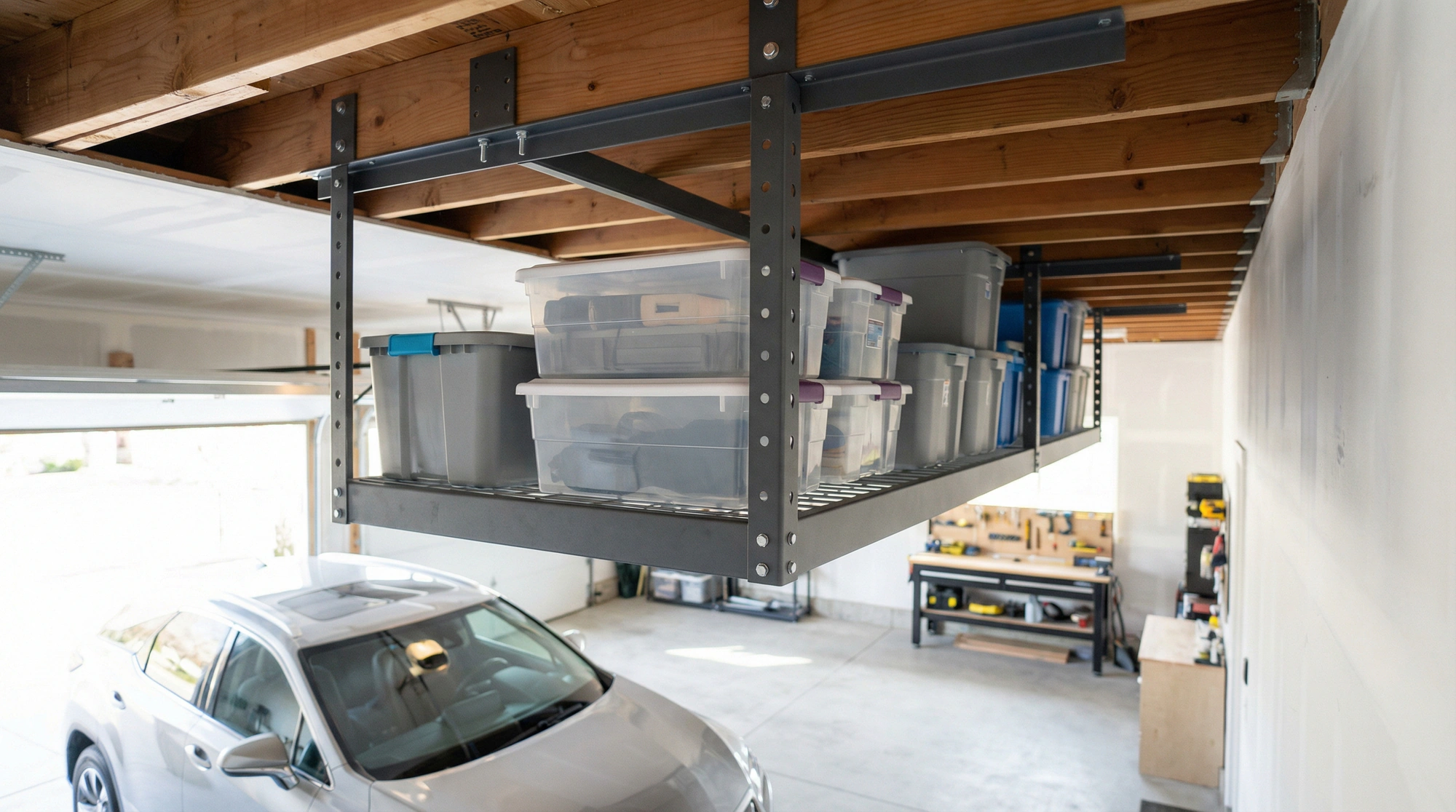
Overhead garage storage is one of those things that seems complicated until you actually do it. Then you wonder why you waited so long. Garage ceiling storage racks can hold hundreds of pounds of stuff you only need once or twice a year, and they get it completely out of your way.
But here’s where I’m going to annoy some people. This isnt a project you can rush. Install these things wrong and you’ve got a serious safety problem.
The Safety Thing
I need to talk about this first because I’ve seen what happens when people skip steps.
The U.S. Consumer Product Safety Commission recalled about 12,800 overhead garage storage racks in 2022 because defective bolts were causing them to collapse from ceilings. They received 55 reports of racks falling. One person got their face cut up when the corners of a ceiling mounted rack came down.

Same year, another recall from CPSC on a different brand. Eighteen reports of U-shaped buckles failing and storage racks falling from the garage ceiling.
These were properly manufactured products with defective parts. Now imagine what happens when someone installs a perfectly good rack into drywall instead of joists.
I had a ceiling fan tear itself out of a ceiling at 2:47 AM back in 2003. That was maybe twenty pounds spinning at full speed and it was terrifying. A 400-pound storage rack coming down while youre working underneath it. I dont want to think about it.
Finding Your Joists
This is where I probably care too much. But every time someone asks me about overhead garage storage, this is where I spend most of the conversation, because if you get this wrong nothing else matters.
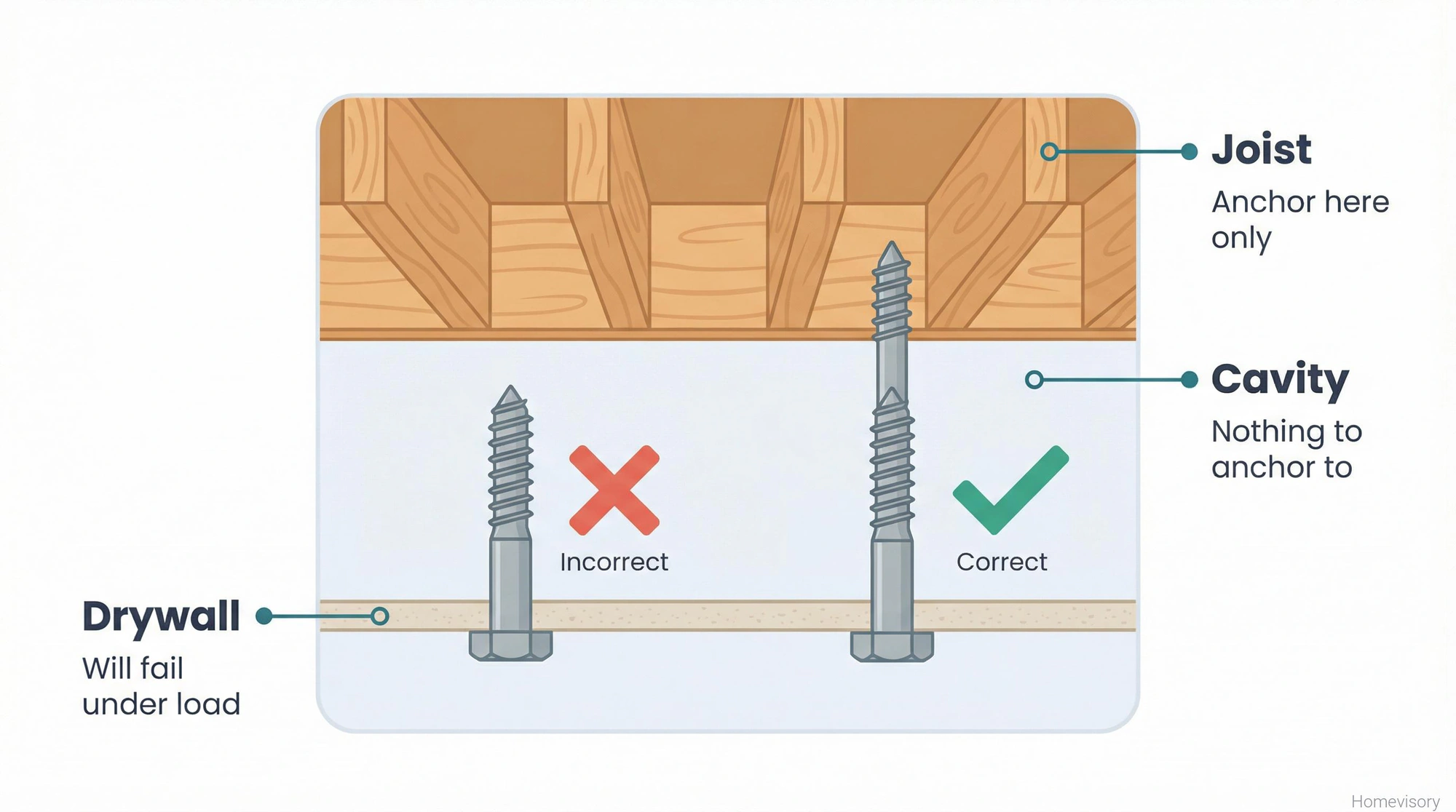
Your garage ceiling is either attached to trusses or joists depending on how your house was built and those are the only things you can safely anchor into. The drywall or ceiling material itself holds almost nothing, its just there to cover things up, and I’ve watched people drill lag bolts directly into it and act surprised when everything comes down three months later. You need a stud finder, a good one, not the $12 thing from the checkout aisle. And then you need to verify what you find by driving a small nail or using a longer bit to make sure youre actually hitting wood. I check every single mounting point at least twice because Ive been wrong before and Id rather have a few extra nail holes to patch than a storage rack on my garage floor.
Mr. Davis, my woodshop teacher back in Atlanta, used to say measure twice cut once. Hes been gone since 2012 but I hear him every time I’m about to drill into something. Measure twice, drill once. Find the joist twice, anchor once.
Weight Limits
Heres the thing nobody wants to hear. Your garage ceiling probably cant hold as much as you think.
According to Garage Transformed, the International Residential Code says ceilings in single-story homes are only designed to support a constant load of 5 pounds per square foot plus a live load of 10 pounds per square foot. Multi-story homes are different, the lower-level ceilings need to support the floor above them, so theyre rated for 20 pounds per square foot constant load.
Most overhead storage racks are somewhere between 4x4 feet and 4x8 feet. Thats 16 to 32 square feet. If your ceiling is rated for 15 pounds per square foot total, youre looking at 240 to 480 pounds as a theoretical max for the ceiling itself, not counting what the rack can handle.
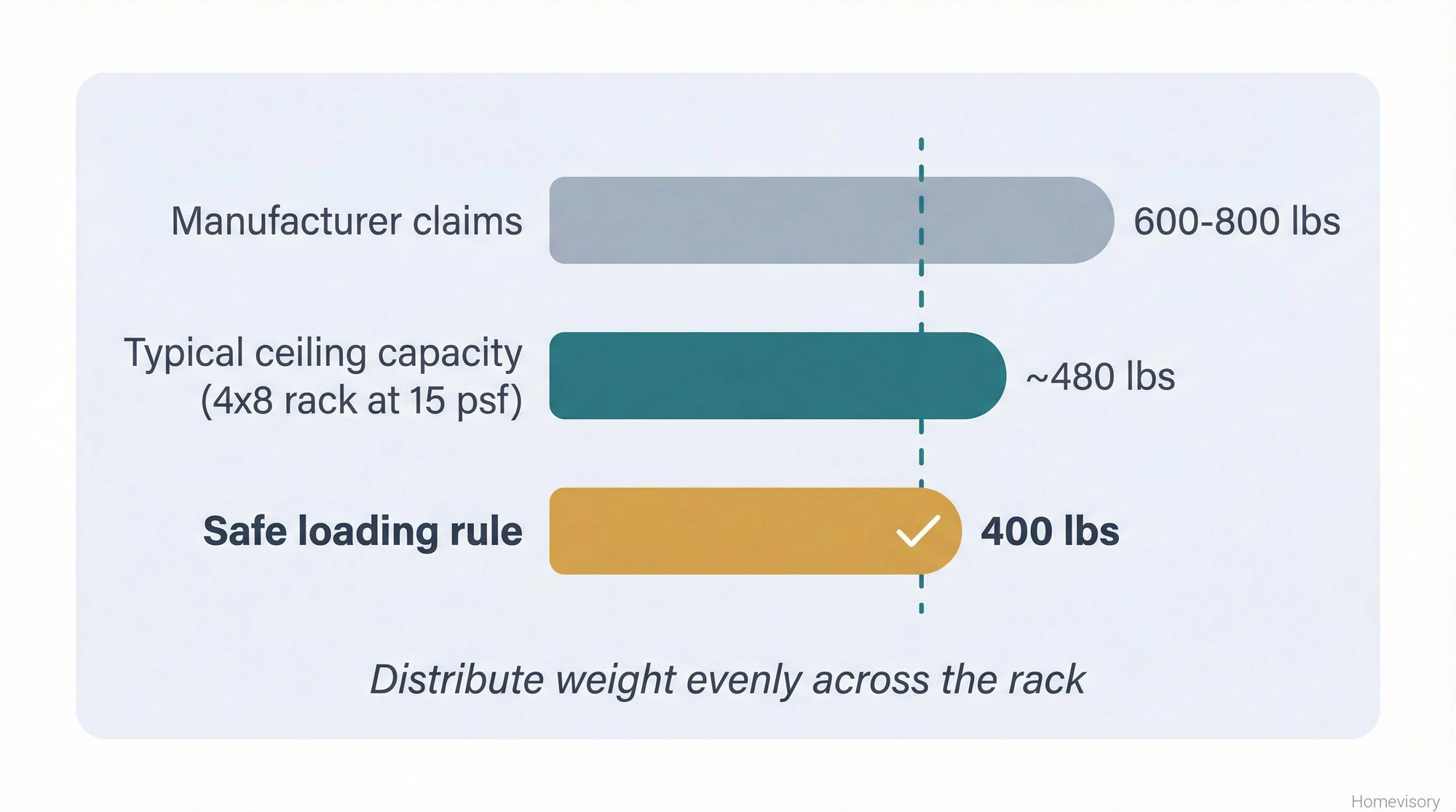
Now, the manufacturers will tell you their rack holds 600 pounds or 800 pounds. ONRAX claims up to 800 pounds on their heavy-duty units. Some motorized systems can handle 700 pounds. But that doesnt mean your ceiling can take it.
If youre planning to store heavy stuff, a structural engineer can tell you exactly what your joists and trusses can support. That costs between $300-500 per hour according to the same source. Most people dont need that. Most people are storing holiday decorations and camping gear, not engine blocks.
My rule: stay under 400 pounds total and distribute the weight evenly. If you feel like you need more than that, get a professional opinion.
What to Actually Buy
I’m not getting into brand wars here. People get weird about this stuff like theyre defending a sports team.
What matters:
Steel gauge. Lower numbers are thicker and stronger. 14-gauge is solid. 18-gauge is cheaper and lighter-duty.
Hardware quality. Those recalls I mentioned were about defective bolts and buckles. Check reviews for any reports of hardware failures, not just complaints about instructions.
Size. Measure what youre storing. Measure your ceiling height. Measure where your garage door opens to. Then buy accordingly. Home Depot’s guide says these should be installed at heights safe and convenient for whoever uses them most. Obvious but people forget.
Price range. Youre looking at $120 to $600 depending on size. The 4x4 units are cheaper. The 4x8 units cost more. Motorized lifts that raise and lower are at the top of that range.
Height adjustable options typically range from 18-33 inches or 24-45 inches from the ceiling. Pick a height that works for you and your vehicle if you park inside. Whatever. Moving on.
Installation
Most systems take 2-4 hours depending on your garage size and how many racks youre putting up. That assumes you know what youre doing and have the right tools.
You need:
- Stud finder
- Drill with various bits
- Socket wrench set
- Level (I use my Stabila, the one I call “The Plano Reminder”)
- Step ladder or better yet a small scaffold
- Another person
That last one isnt optional. Youre holding a steel frame above your head while trying to drill into a ceiling. Do not do this alone.
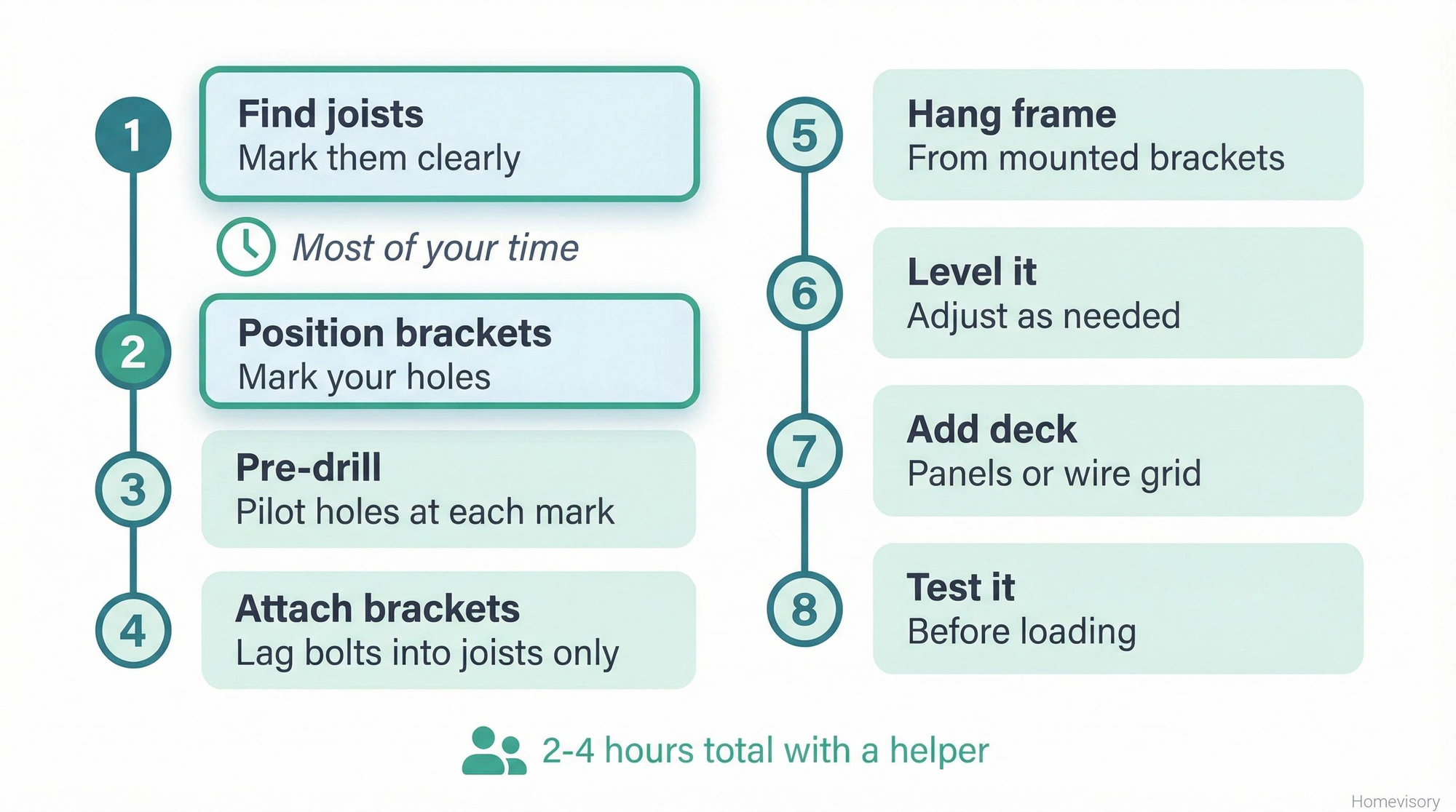
Basic process:
- Find your joists. Mark them clearly.
- Hold up the mounting brackets and mark your holes.
- Pre-drill pilot holes.
- Attach brackets with lag bolts into joists, not drywall.
- Hang the frame from the brackets.
- Level it. Adjust as needed.
- Add the deck panels or wire grid.
- Test it before loading it up.
When I installed mine in our Palm Beach garage, I spent more time on steps 1 and 2 than everything else combined. Raquel asked why I was staring at the ceiling for an hour. I told her I was having a conversation with Mr. Davis.
What Goes Up There
Garage overhead storage is for stuff you dont need often. Thats the whole point.
Good candidates:
- Holiday decorations
- Seasonal sports equipment
- Camping gear
- Luggage
- Bulk paper goods and supplies
- Out-of-season clothes in bins
Bad candidates:
- Anything youll need weekly
- Anything heavy concentrated in one spot
- Liquids that could leak
- Anything you dont want to climb a ladder to reach
I keep our Christmas stuff up there, the camping gear we use maybe twice a year, and about six bins of things Raquel calls “memory boxes” that she wont throw away but also never opens. Works fine. If you still need more floor space after ceiling storage, my full garage organization guide covers wall systems, shelving, and everything else.
That Time With My Dad
I helped my dad organize his garage when I was maybe sixteen. We had just moved to Texas and he was trying to make the new place feel like ours. He had this system where everything had to be visible, he didnt trust putting things in bins where he couldnt see them. So we built these open shelves along every wall and he labeled everything with a label maker he bought at Office Depot. It took us a whole weekend. I remember being annoyed that we were spending Saturday doing this instead of whatever I thought was more important at sixteen.
He still has that garage. Still uses those shelves. Probably hasnt changed the labels in thirty years.
Anyway.
The Homevisory Part
Look, if youre reading this you probably have a list of home stuff you keep meaning to do. Garage storage is one of those projects that sits on the list for years because it seems like a big deal.
Its not a big deal. Its a weekend. But you have to actually schedule it. If you want to see how ceiling storage fits into the bigger picture of garage maintenance, our complete garage door guide covers everything from doors to openers to organization.
Thats what we built Homevisory for. It tracks all your home maintenance tasks, reminds you when things need attention, and helps you stop forgetting about the stuff that matters. The garage storage thing, the filter changes, the gutter cleaning, all of it.
Sign up free at our Homevisory home task manager. Get your list together. Then go install some ceiling racks and wonder why you didnt do it five years ago.