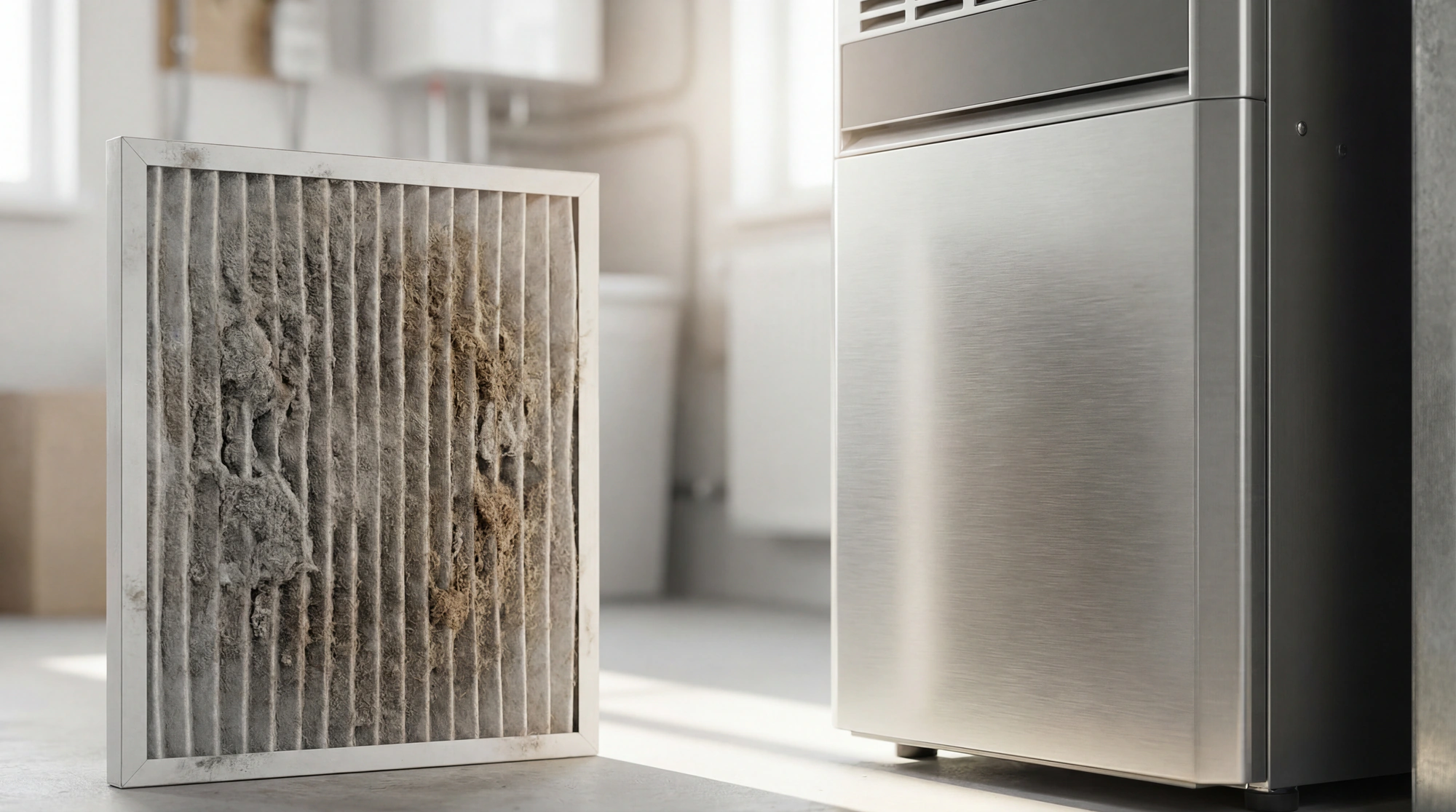
The Real Answer No One Gives You
Everyone wants a simple answer to how often to change air filter in their HVAC system. Thirty days. Ninety days. Whatever the package says.
Heres the problem. The package doesnt know your house. It doesnt know if you have three dogs or zero. It doesnt know if you live in Palm Beach where the humidity grows things in places you didnt know things could grow, or if youre in Arizona where dust is basically a food group. The generic advice is useless.
I’ve been doing this for over thirty years. Ive seen systems choked to death by filters that should have been changed three months ago. Ive also seen people waste money changing filters every two weeks because someone told them thats what good homeowners do. Both are wrong.
So heres what actually matters.
Filter Type Changes Everything
The question isnt really how often to change furnace filter. The question is what kind of filter are you changing. A 1-inch fiberglass filter and a 4-inch pleated filter are completely different animals. Treating them the same is like saying you should change the oil in your lawnmower as often as your truck. Makes no sense.
1-Inch Fiberglass Filters
These are the cheap ones. The ones that cost three dollars and look like they couldnt catch a tennis ball let alone dust. Their job isnt really to clean your air. Their job is to keep large debris from getting into your blower motor. Thats it.
Change these every 30 days. Maybe 45 if you live alone and dont have pets and keep your house sealed like a submarine. But realistically, 30 days. They fill up fast because they have almost no surface area. The dust sits on the front and restricts airflow quickly.
I dont recommend these for most people but if youre using them, dont stretch it.
1-Inch Pleated Filters
Better than fiberglass. The pleats give you more surface area which means more dust capacity before air restriction becomes a problem. These are what most people have and most people are confused about.
The package says 90 days. Sometimes it says 60-90 days. Heres the truth: in a normal house with normal usage, 60 days is safer. If you have pets, 45 days. If you have multiple pets or someone with respiratory issues, 30 days.
I know that sounds like Im just telling you to change it more often than the package says. I am. The package is written by people who want you to feel good about buying their filter. They want you to think youre getting three months out of it. You probably arent.
4-Inch and 5-Inch Pleated Filters
Now were talking. This is what I have in my house. This is what I recommend to basically everyone who asks.
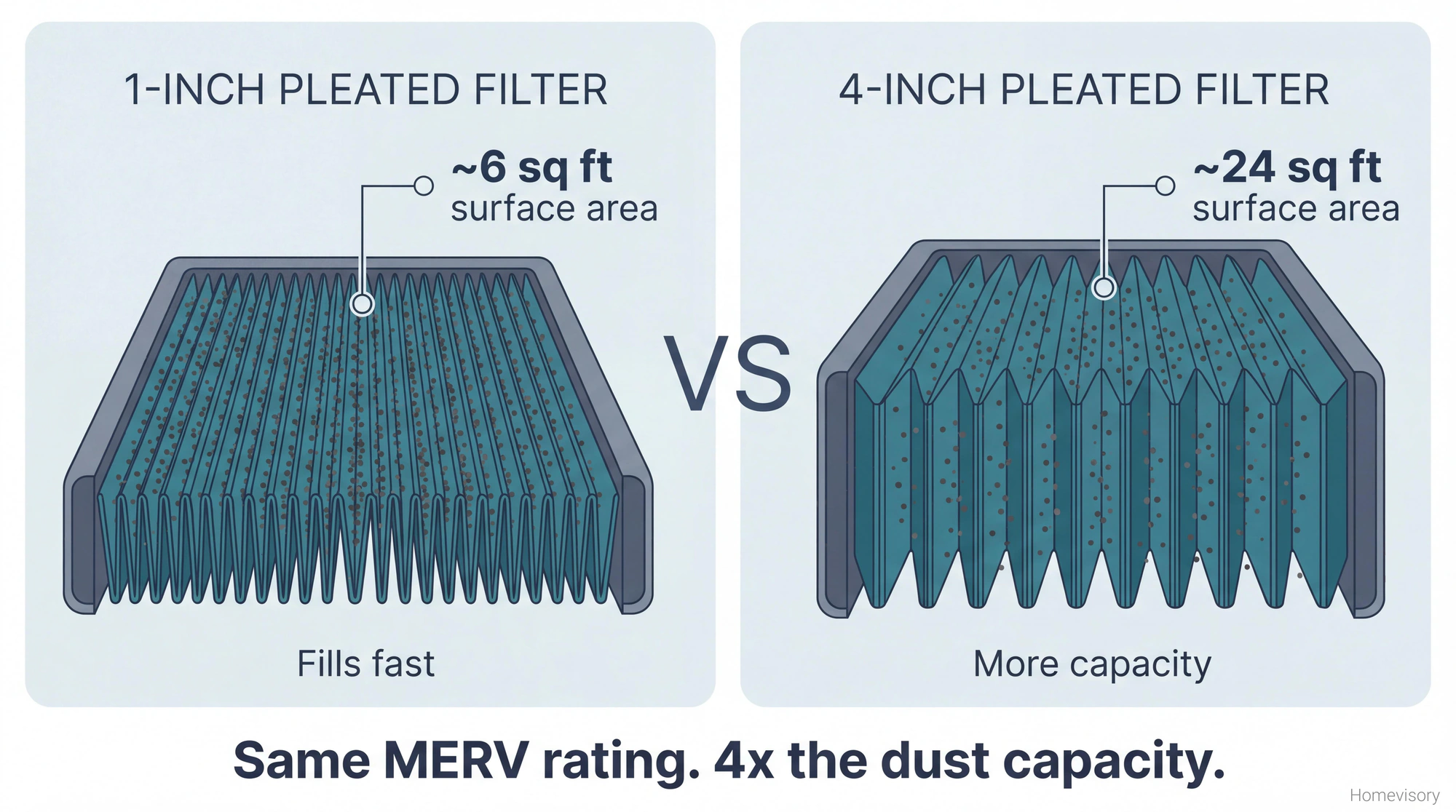
A 4-inch pleated filter has roughly four times the surface area of a 1-inch pleated filter. Some people think thats obvious because its four times thicker but thats not quite how it works, the pleats are deeper and there are more of them and the whole thing is designed differently. The point is you get massively more filter media which means massively more capacity which means the filter can hold more dust before it starts choking your system. The MERV rating matters too and Ill get to that but thickness is the foundation. You can have a MERV 13 filter in a 1-inch frame and itll clog in three weeks because theres nowhere for the particles to go. You can have the same MERV 13 in a 4-inch frame and itll last four to six months easy. People obsess over the rating and ignore the thickness and thats backwards. Get the thickness right first, then worry about the rating.
These filters genuinely can go 6 months between changes in most homes. Some manufacturers say 12 months and I think thats optimistic but 6 months is reasonable. If you have pets or allergies, check at 4 months.
The catch is your system needs to be set up for them. You cant just shove a 4-inch filter where a 1-inch filter used to go. You need the right housing. If you dont have it, getting one installed runs maybe $150-200 depending on your setup. Worth it.
MERV Rating Matters But Not How You Think
Everyone talks about MERV rating like higher is automatically better. Its not that simple.
MERV stands for Minimum Efficiency Reporting Value. According to the EPA, its a rating system developed by ASHRAE (American Society of Heating, Refrigerating and Air-Conditioning Engineers) that measures a filter’s ability to capture particles between 0.3 and 10 microns. MERV 8 catches stuff like dust and pollen. MERV 11 catches smaller stuff like mold spores and pet dander. MERV 13 catches even smaller stuff like smoke particles and some bacteria.
Heres what nobody tells you: higher MERV ratings also mean more air restriction. The filter is denser. It catches smaller particles because the holes are smaller. Smaller holes mean your blower has to work harder to push air through.
If your system wasnt designed for high-MERV filters and you slap a MERV 16 hospital-grade filter in there, youre going to stress your blower motor. Ive seen this kill systems. Not immediately but over a couple years, the motor burns out because its been working overtime every day.
For most homes, MERV 8-11 is the sweet spot. If someone has serious respiratory health concerns, go to MERV 13 but make sure your system can handle it. Anything above MERV 13 in a residential system is usually overkill unless youve specifically had an HVAC tech tell you its fine.
And no matter the MERV rating, a clogged filter is worse than a lower-rated clean filter. Air quality depends on air actually moving through the filter.
Why I Care Too Much About This
My mom had asthma. Growing up in Atlanta in the eighties, pollen season was brutal. Im talking about that yellow-green dust that covers everything, your car, your porch furniture, the dog, and you could see it floating in the air on bad days. She would have these episodes where she couldnt catch her breath and my dad would be running around opening windows, no wait closing windows, checking if the AC was on, trying to figure out what was making it worse.
I dont know if their filters were part of the problem. Probably. Nobody talked about filter efficiency back then, at least not in our house. You changed it when you remembered and you remembered when the house felt stuffy. Thats how it worked.
She still has issues with her breathing. Shes in her late seventies now and my dad calls me sometimes about their HVAC because he wants to make sure its doing everything it can. I go over there and check it myself. The filter is always clean because I put it on a schedule for them. They dont have to think about it.
Anyway.
The Inspection Method
My dad Curtis worked in a factory for forty years. He used to say he could tell when a machine was about to have problems before any gauge or sensor picked it up. He called it reading the machine. You pay attention. You notice when something sounds different or runs different or smells different. Thats not mystical. Thats just experience.
Same thing with filters. You can follow schedules all you want but nothing beats actually looking at the thing.
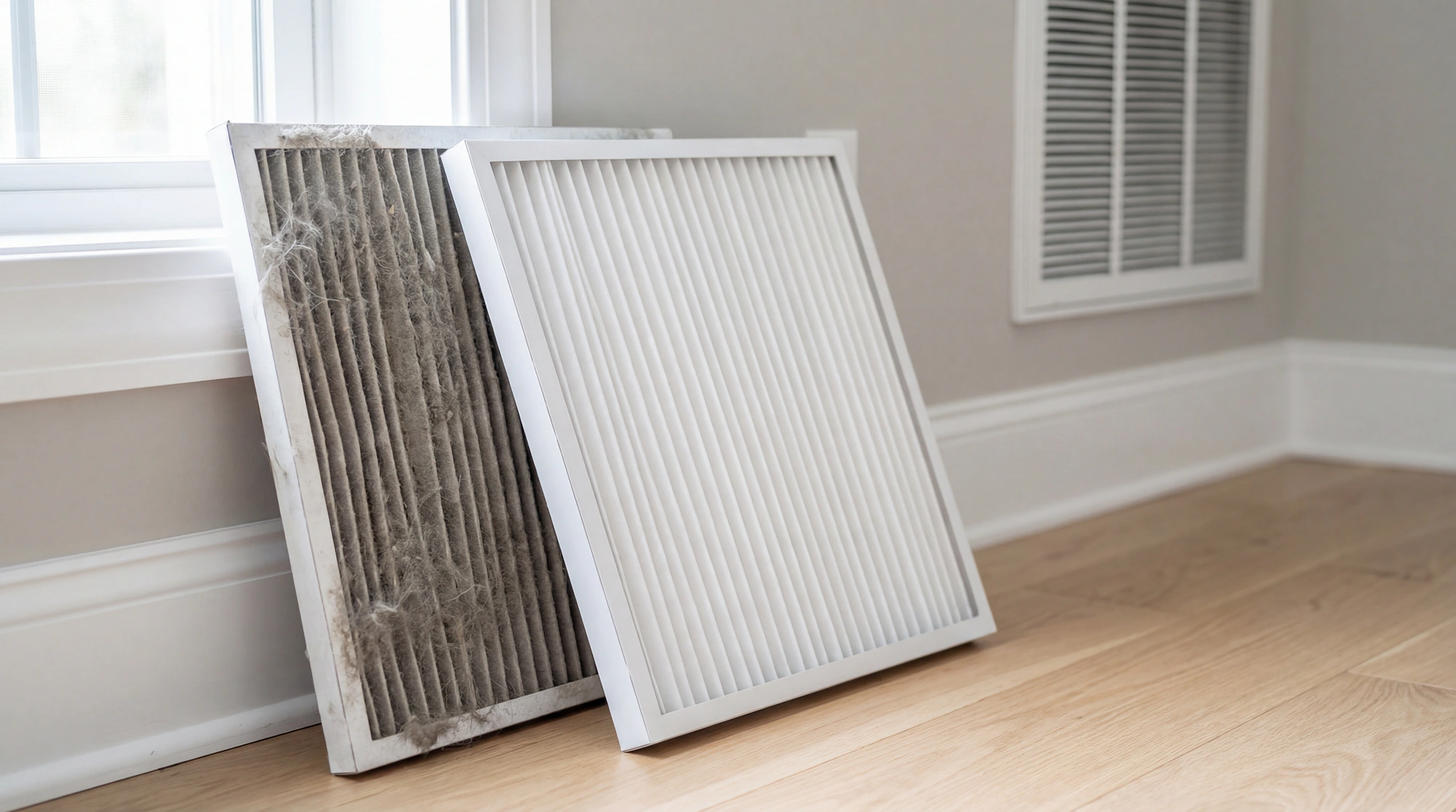
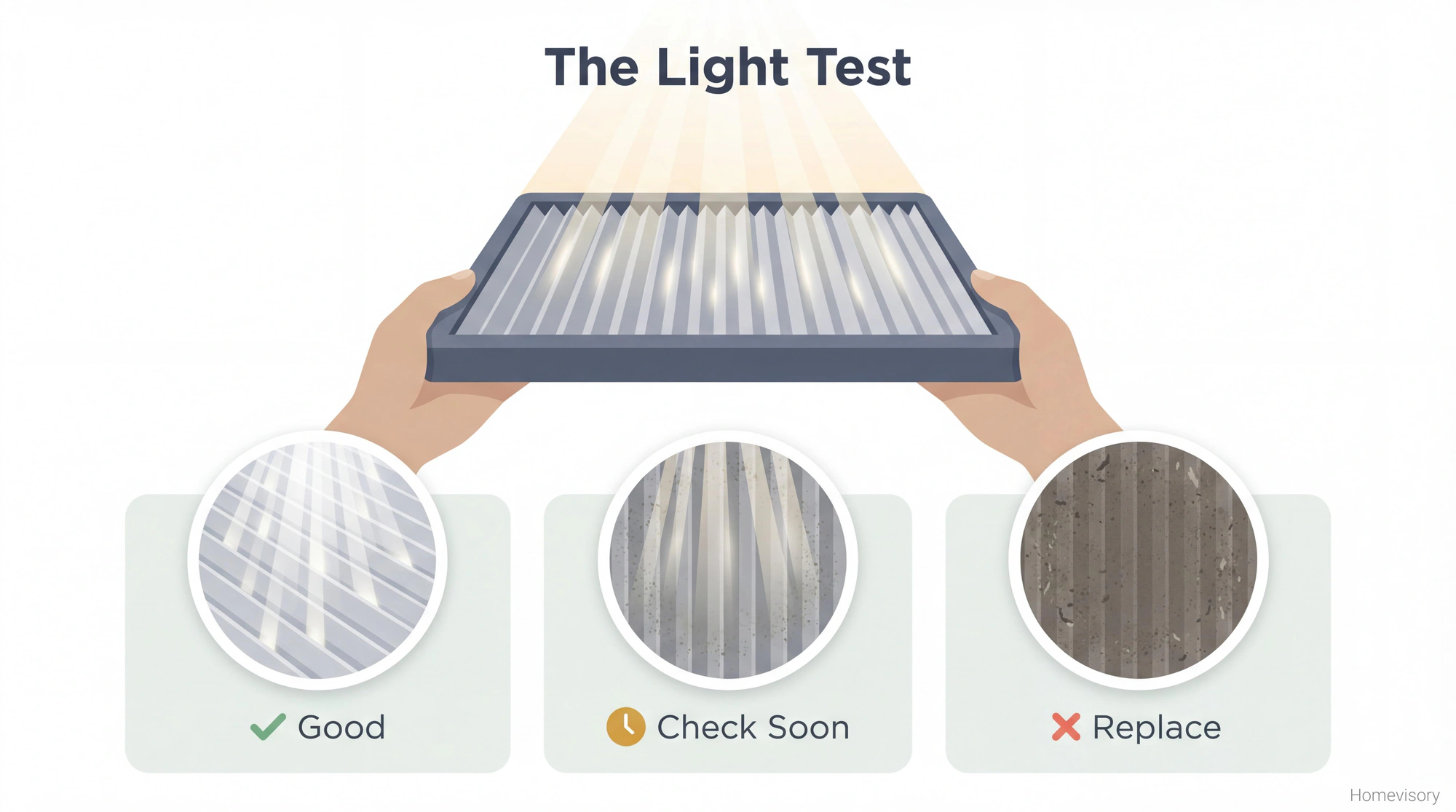
Pull your filter out. Hold it up to light. If you can see light through it clearly, its got life left. If you can barely see light, or if the filter is solid gray or brown, its done. If its growing something, which I have seen more than once in Florida, its very done.
Thats it. Not complicated.
I check mine every month even though I dont change it every month. Takes thirty seconds. You open the return vent or the filter housing, you slide it out, you look at it, you put it back. If your schedule says 90 days but the filter is packed at 60, change it at 60. If your schedule says 30 days but it still looks decent, check again in two weeks.
Schedules are starting points. Inspection is how you know.
Usage Patterns Change Everything
This is why generic advice fails. How often you run your system completely changes how often to change your air filter.
If youre in San Diego where the weather is perfect and you run your system maybe four hours a day, your filter lasts forever. If youre in Phoenix or Houston or Palm Beach where the system runs sixteen hours a day for months at a time, that filter is working four times harder.
Same with occupancy. I have four kids. Had four kids in the house at once for years, plus two dogs. Dust, dander, hair, tracked-in dirt. Our filters worked harder than someone living alone.
Think about your specific situation:
- How many hours per day does your system run
- How many people live there
- Pets (and what kind, because a golden retriever sheds more than a poodle)
- Do you open windows regularly or keep the house sealed
- Construction nearby or recent renovations
- Allergy season in your area
All of this matters. A 90-day filter might last 90 days in one house and 40 days in another.
Chicago Winters Taught Me Something
I worked in Chicago for a stretch in the nineties. Commercial renovations, different buildings around the city. Thats where I learned what real cold feels like. Im talking about cold where your eyelashes freeze if you blink too slow. Cold where the wind off the lake goes through your jacket like its not there.
Those buildings ran their furnaces constantly from November through March. Sometimes April if winter felt like being cruel. The filters in those systems needed attention every single month because the system never stopped. Dust emissions accumulated faster because air moved through the ducts more. More air movement means more particles getting filtered means faster filter lifespan depletion.
I think about that whenever someone in Florida asks me if they really need to change filters as often in winter since they dont run heat much. Yeah. But your AC runs eight months straight. Same principle.
Electronic and Washable Filters
Some systems have electronic air cleaners or washable permanent filters. Im not getting into those here. They work differently, they have their own maintenance schedules, and honestly I dont love them. The washable ones never seem to dry fully and the electronic ones need cleaning and they make a clicking sound when theyre dirty that drives me insane.
If you have one, follow your manufacturers instructions. Or call someone who likes them because I dont.
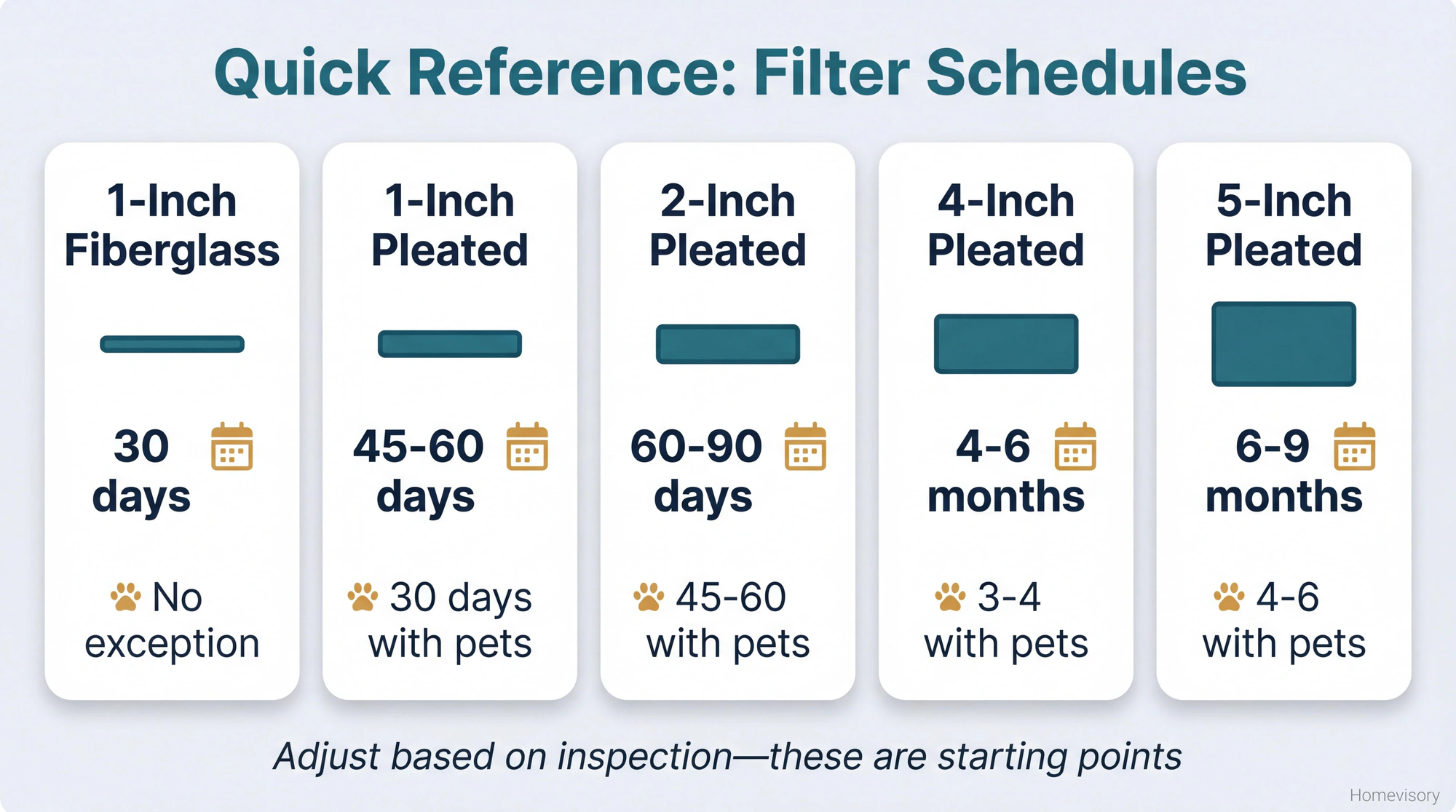
Filter Replacement: The Actual Schedule
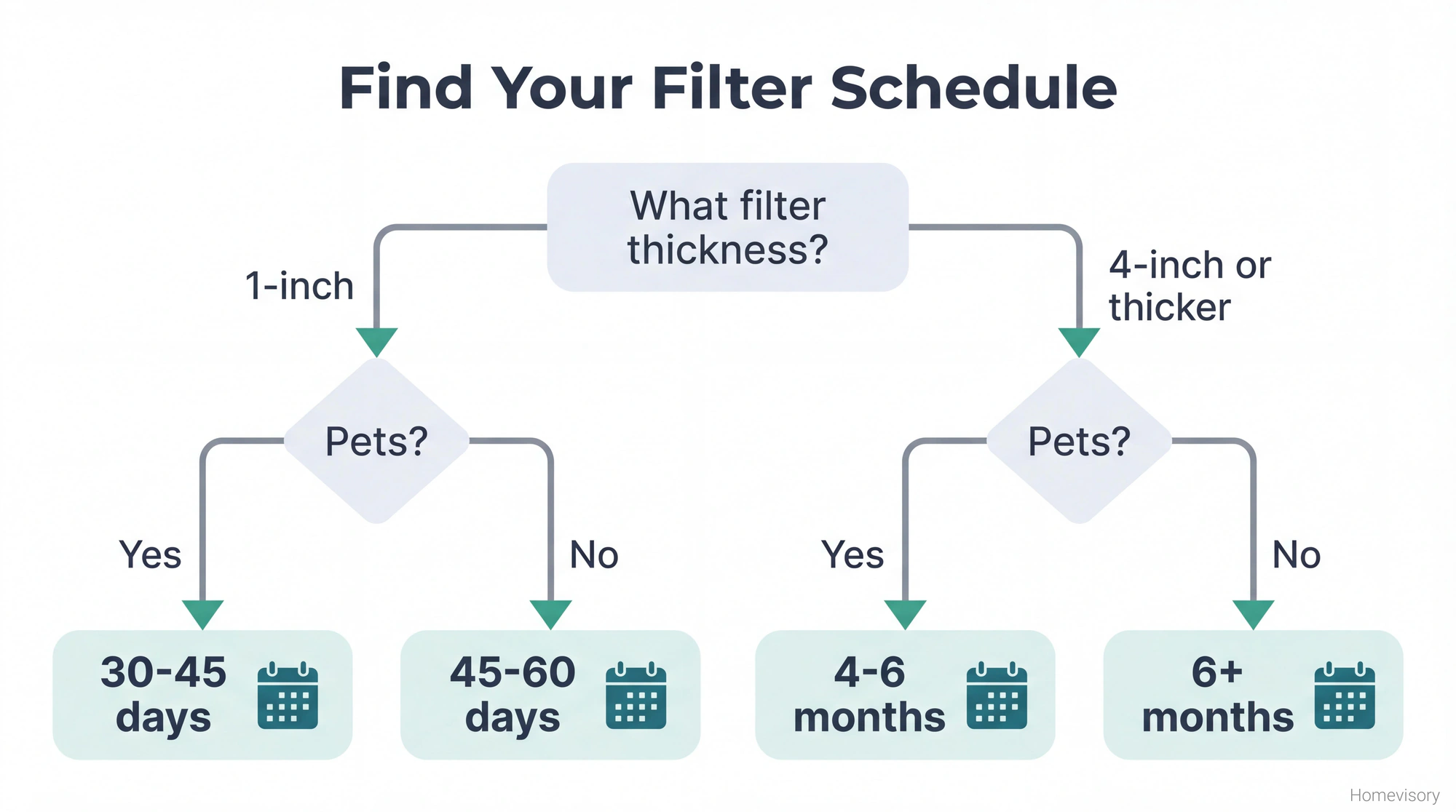
Fine. You want a chart. Here:
1-inch fiberglass: 30 days, no exceptions
1-inch pleated (MERV 8-11):
- Normal household: 60 days
- Pets: 45 days
- Multiple pets or allergies: 30 days
2-inch pleated:
- Normal: 90 days
- Pets: 60 days
4-inch pleated:
- Normal: 6 months
- Pets or allergies: 4 months
5-inch pleated:
- Normal: 6-9 months
- Pets or allergies: 4-6 months
Adjust based on inspection. These are starting points.
Stop Buying Marketing
The expensive filters with the fancy boxes and the claims about removing 99.97% of everything including bad vibes are usually not worth it for residential HVAC maintenance. Those are HEPA-level filters designed for hospitals and clean rooms. Your home system probably cant handle them without modification.
Buy decent mid-range filters in bulk. A MERV 10 or 11 pleated filter in the right thickness for your system, changed on schedule, will do more for your air quality than an expensive MERV 16 filter that clogs in three weeks and suffocates your blower.
Whatever. Just change the filter. Thats the real message. And add it to your home maintenance checklist so you stop relying on memory.
What Homevisory Does For You
Look, I know this is a lot to remember. Filter thickness, MERV ratings, inspection schedules, all of it varies by your specific situation. Thats exactly why we built Homevisory.
You tell us what filter you use, what system you have, how many pets are destroying your furniture. We build a maintenance schedule that actually fits your life. Not generic advice from a filter box. Real reminders based on your house, your usage, your climate. For the full picture on keeping your system healthy, check our complete HVAC maintenance guide.
You can sign up for free. We handle the tracking so you dont have to think about it. Thats what we do here at Homevisory.
Ready to stay on top of your home maintenance? Sign up for the Homevisory home task manager - it’s free.