How to Balance a Ceiling Fan: Stop Wobbling & Noise
Learn how to balance a ceiling fan in 30 minutes with simple DIY steps. Fix wobbling fans safely without an electrician - just a ladder and $4 kit.

Homevisory offers a home maintenance app, but our editorial content is independent. Product recommendations are based on merit, not business relationships.
Why Your Ceiling Fan Wobbles
A wobbling ceiling fan is one of those things people ignore for way too long. It starts as a slight movement, barely noticeable, and then six months later your fan sounds like a helicopter trying to land in your living room. I get it. You figure its just a fan, its fine, itll work itself out. It wont work itself out. It gets worse.
The good news is learning how to balance a ceiling fan is genuinely simple. You dont need an electrician. You dont need special skills. What you need is about thirty minutes, a ladder, maybe a screwdriver, and a balancing kit that costs four dollars.
I’ve fixed hundreds of ceiling fans over the years. I’ve also made one major mistake with a ceiling fan that I’ll get to later. The point is, wobble happens for a handful of predictable reasons and the fixes are straightforward once you know what youre looking for.
First Things First
Before you climb up there and start messing with things, turn the fan off. Not just the wall switch. Give it a minute to stop spinning completely. This sounds obvious but I’ve watched people try to check blade alignment while the fan is still coasting to a stop. Dont be that person.
The Home Depot recommends maintaining at least 30 inches of clearance from the tip of the fan blades to the nearest object. Thats not just for installation. Thats for you standing on a ladder trying to work on the thing without hitting your head or knocking into a light fixture.
Also, a small amount of movement is normal. While a wiggle up to 1/8-inch is considered acceptable, anything more than that and you have a problem worth fixing. I’ve had people call me about fans that were moving half an inch or more and they’d been living with it for years. Why. Why would you do that.
The Mounting Problem Nobody Checks
Here’s what I care about way more than most people think I should care about it. The electrical box.
Your ceiling fan hangs from a box in the ceiling. If that box isnt rated for a fan, or if its not secured properly to a joist or support brace, your fan is going to wobble no matter what else you do. You can balance the blades perfectly. You can tighten every screw. The fan will still wobble because the foundation is wrong.
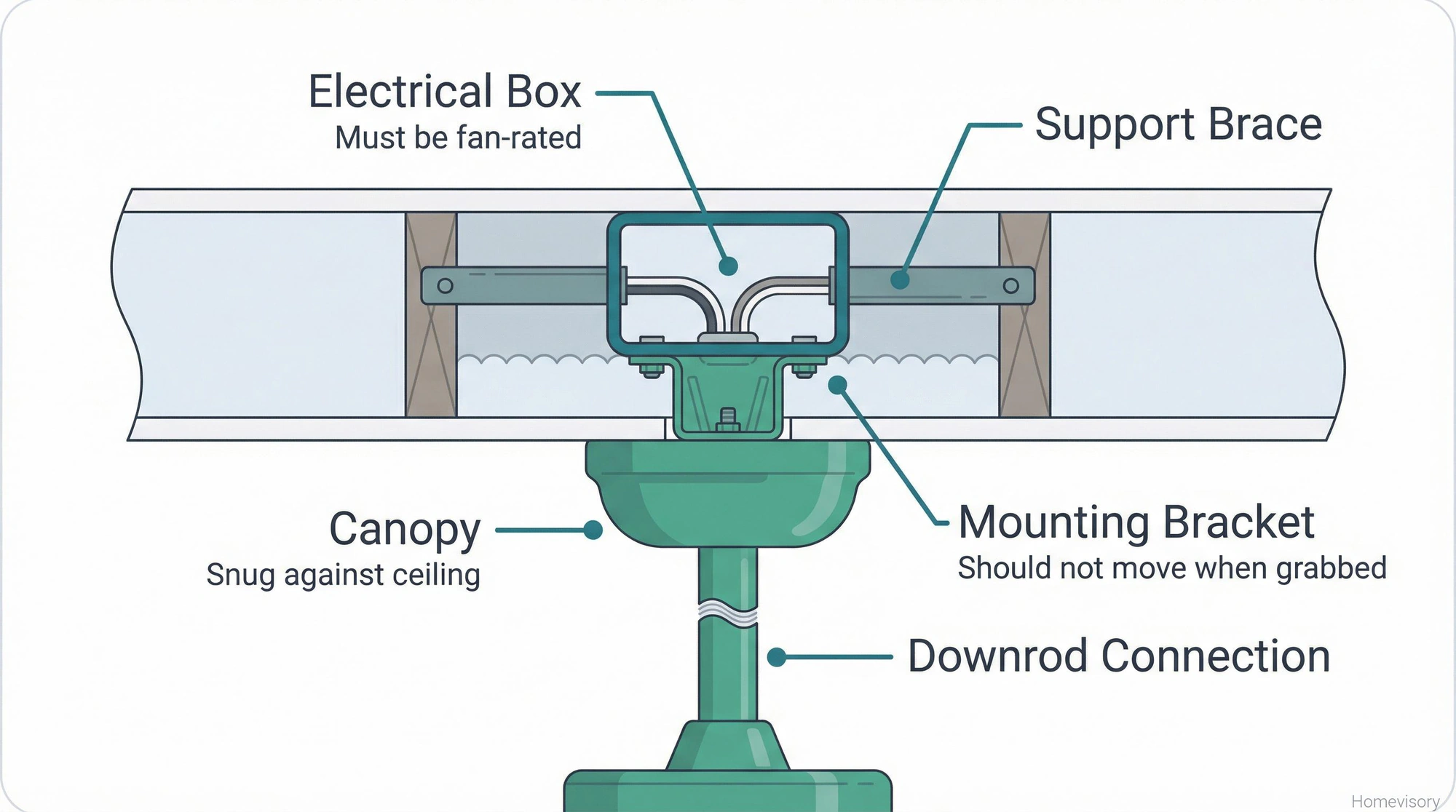
The National Electrical Code is specific about this: outlet boxes used as the sole support for a ceiling fan must be listed and marked as suitable for that purpose. Standard electrical boxes, the kind used for light fixtures, often dont meet this requirement. The box needs to support fans up to 35 pounds without additional marking, and if your fan is heavier than that, the box has to be specifically rated and marked for that weight.
This is where I become insufferable. I’ve seen so many fans mounted to boxes that were never meant to hold them. The homeowner installed the fan themselves or hired someone cheap and now three years later the whole thing shakes because the box is slowly working loose from the ceiling. The screws that connect the fan to the mounting bracket should be tight. The bracket itself should be secure. If you grab the mounting bracket and it moves at all, thats your problem right there.
My dad used to say, about factory equipment, he used to say “if something sounds wrong, it probably is wrong.” He was talking about conveyor belts and stamping machines, but the principle applies. A ceiling fan that sounds like its struggling is struggling. A fan that wobbles is telling you something is loose or misaligned or both.
Check the downrod connections while you’re up there. The canopy, thats the decorative cover that hides the mounting hardware, should be snug against the ceiling. The screws holding the motor housing to the downrod should be tight. All of it. I’ve fixed wobbling fans by just tightening three screws that had worked loose over time.
Clean Your Blades
Dust your fan. Wipe down each blade with a damp cloth. Make sure no blade has accumulated more gunk than another.
There. Moving on.
The Blade Alignment Check
This is where people usually start but it shouldnt be where you start. You should have already checked the mounting. But fine, lets talk about blades.
Each blade should sit at the same height and the same angle as every other blade. Sounds simple. Gets missed constantly.
Get a tape measure or a yardstick. Stand on your ladder and pick one blade. Measure from the ceiling to the tip of that blade, or from the ceiling to the same point on the blade bracket. Write it down. Do the same for every blade. If one blade is noticeably higher or lower than the others, that blade is probably bent or the blade bracket is warped.
Blade brackets are the metal arms that connect each blade to the motor hub. They’re usually stamped sheet metal and they bend easier than you’d think. You can try bending a bracket back into alignment by hand, carefully, a little at a time. Sometimes it works. Sometimes the bracket is too far gone and you need a replacement.
This is also when you check if blades are cracked or warped. Wood blades especially can warp over time in humid environments. Here in Palm Beach the humidity is relentless and I’ve seen blades that looked like potato chips. If a blade is warped, replace it. You cant balance a warped blade.
Using a Balancing Kit
This is the part where I get long-winded because this is the actual fix for most ceiling fan wobble.
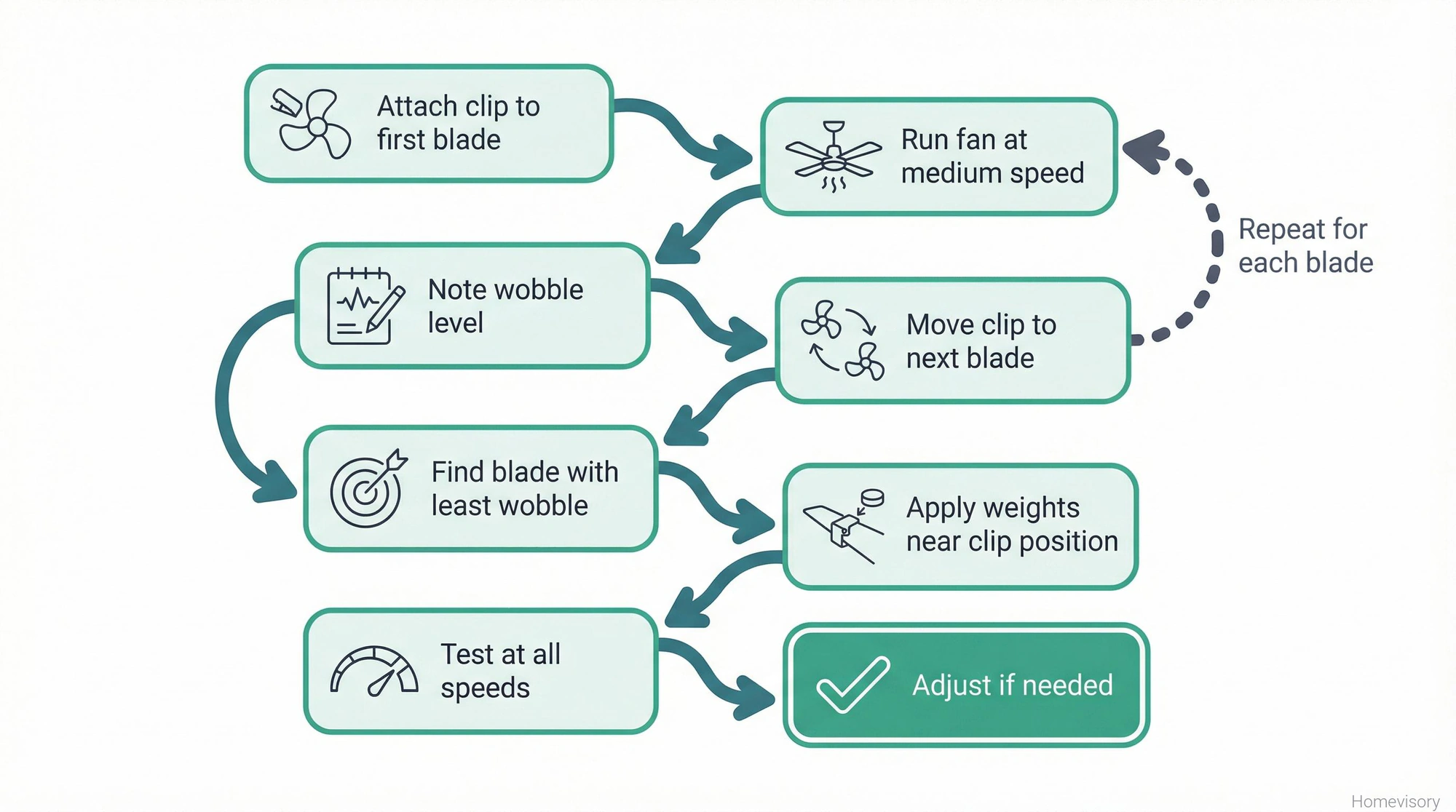
A ceiling fan balancing kit costs three or four dollars at any hardware store and comes with a plastic clip and a set of small adhesive weights. The clip goes on the back edge of a blade to help you identify which blade is causing the problem. You move it from blade to blade, running the fan at medium speed after each move, until you find the blade position where the wobble is least noticeable. Once you identify the problem blade, you stick the weights on top of that blade, near the center line, usually close to the clip position that gave you the best results. You might need one weight, you might need three, you adjust until the fan runs smooth. The whole process takes maybe twenty minutes if you’re being thorough, and its the difference between a fan that sounds like a washing machine on spin cycle and a fan that actually creates a pleasant breeze without announcing itself to the entire house.
A noisy, off-balance ceiling fan leads to inefficient operation and excessive wear on the fan motor. Thats not just an annoyance. Thats shortened equipment life. Fixing a wobbling fan typically costs between $90 and $200 if you hire someone. A balancing kit costs four dollars.
Raquel asked me once why I was standing on a ladder at midnight holding a plastic clip. I told her I was trying to figure out which blade was off. She asked why I couldnt do this during the day. I didnt have a good answer for that.
The Incident I Mentioned
I need to tell you about 2003 because it’s relevant.
I installed a ceiling fan without checking if the electrical box was fan-rated. I was rushing. I had done a hundred ceiling fans and figured I knew what I was doing. The fan worked fine for weeks. Then at 2:47 in the morning it tore out of the ceiling and crashed onto the bed.
The clients were asleep. The fan landed between them. Their cat was on the bed too and that cat never recovered psychologically. I paid for the ceiling repair, the new fan installation, and what I still refer to as the “pet trauma” vet visit.
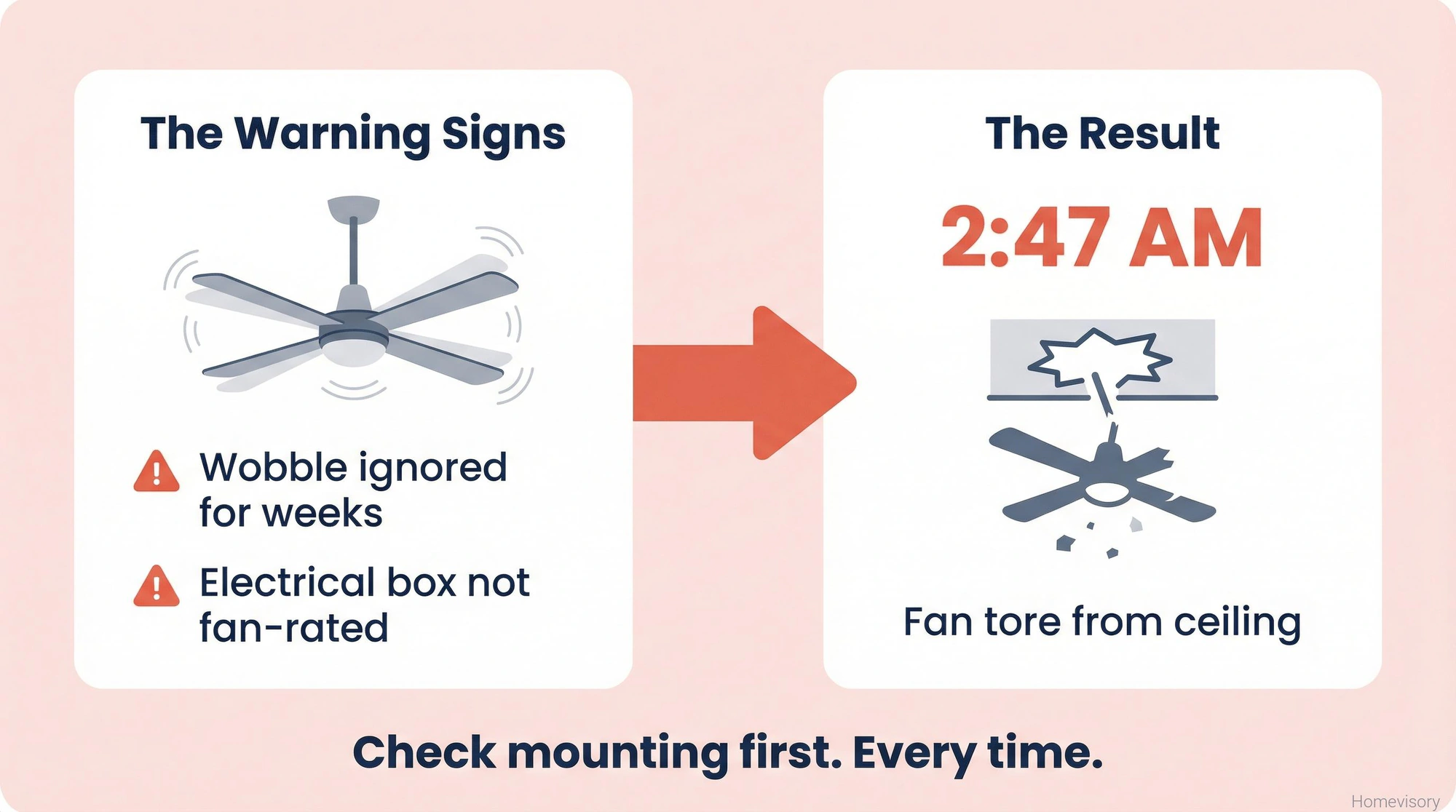
The wobble I’d ignored was a warning. The box wasnt rated. The screws were slowly working loose. Every rotation was making it worse.
When I tell you to check the mounting first, this is why.
When Its Not Worth Fixing
Ceiling fans typically last between five and fifteen years, averaging ten years. If your fan is older than that and wobbling, you might be better off replacing it entirely rather than trying to balance something thats worn out.
Also, ENERGY STAR certified ceiling fans are up to 44% more efficient than conventional fans. If you’re replacing an old fan anyway, get one with the ENERGY STAR label. Your electricity bill will thank you, especially if you’re running fans instead of cranking the AC. And make sure you set the right direction for the season — counterclockwise in summer, clockwise on low in winter. That can help reduce heating costs by up to 15%.
But if your fan is relatively new and the wobble just started, dont replace it. Balance it. The fix takes thirty minutes and the kits are cheap.
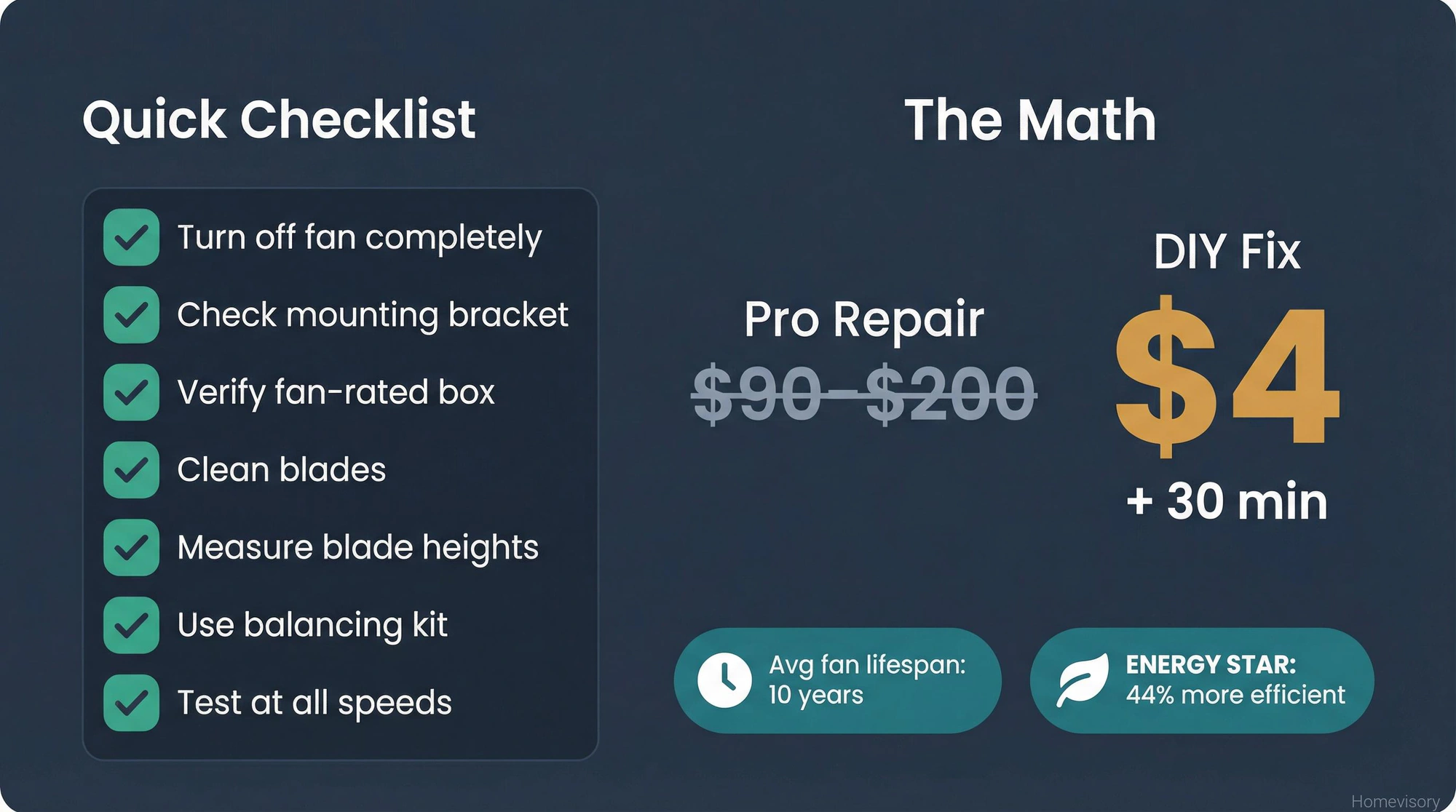
The Quick Checklist
Turn fan off. Let it stop completely.
Check mounting bracket and all hardware connections. Tighten everything.
Check that the electrical box is fan-rated if you have any doubts.
Clean blades.
Measure blade heights to check alignment.
Use a balancing kit to identify and weight the problem blade.
Run fan at all speeds to confirm the fix.
Thats it. You dont need to pay someone $150 for this.
Mr. Davis, my old woodshop teacher, used to make us measure everything twice before we cut. “Check your work before you commit to it,” he’d say. I think about that a lot when I’m standing on ladders in my own house, checking blade distances with a tape measure I’ve probably used a thousand times. He passed away in 2012. I still hear his voice when I’m working. Anyway.
What Homevisory Does
Ceiling fan maintenance is one of those things that should happen once or twice a year and almost never does because people forget. Thats what we do here at Homevisory. The Homevisory home task manager keeps track of seasonal maintenance, reminds you when its time to check things like ceiling fans and HVAC filters and gutters, and helps you stay ahead of problems instead of reacting to them.
You can sign up free. No credit card, no commitment. Just a system that remembers the stuff you shouldnt have to remember yourself.
Mark Carter
Content Writer
Mark Carter is a home maintenance expert with over 20 years of experience helping homeowners maintain and improve their properties. He writes practical, actionable guides for Homevisory to help you tackle common home maintenance challenges.
View all articles by Mark CarterRelated Articles
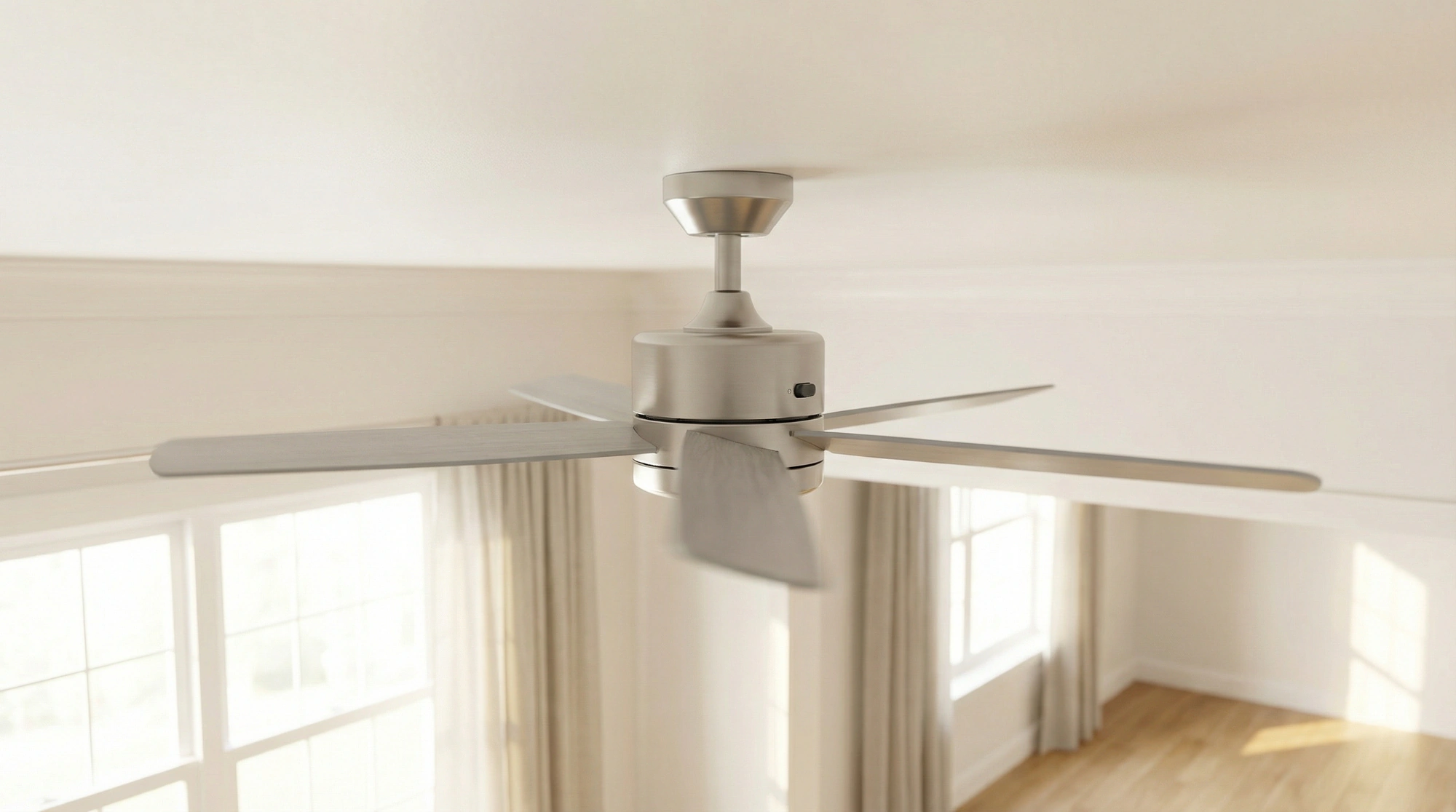
Ceiling Fan Direction: Summer vs Winter Settings Guide
Learn how to set your ceiling fan direction for summer and winter. Counterclockwise for cooling, clockwise for heating. Simple switch saves energy year-round.
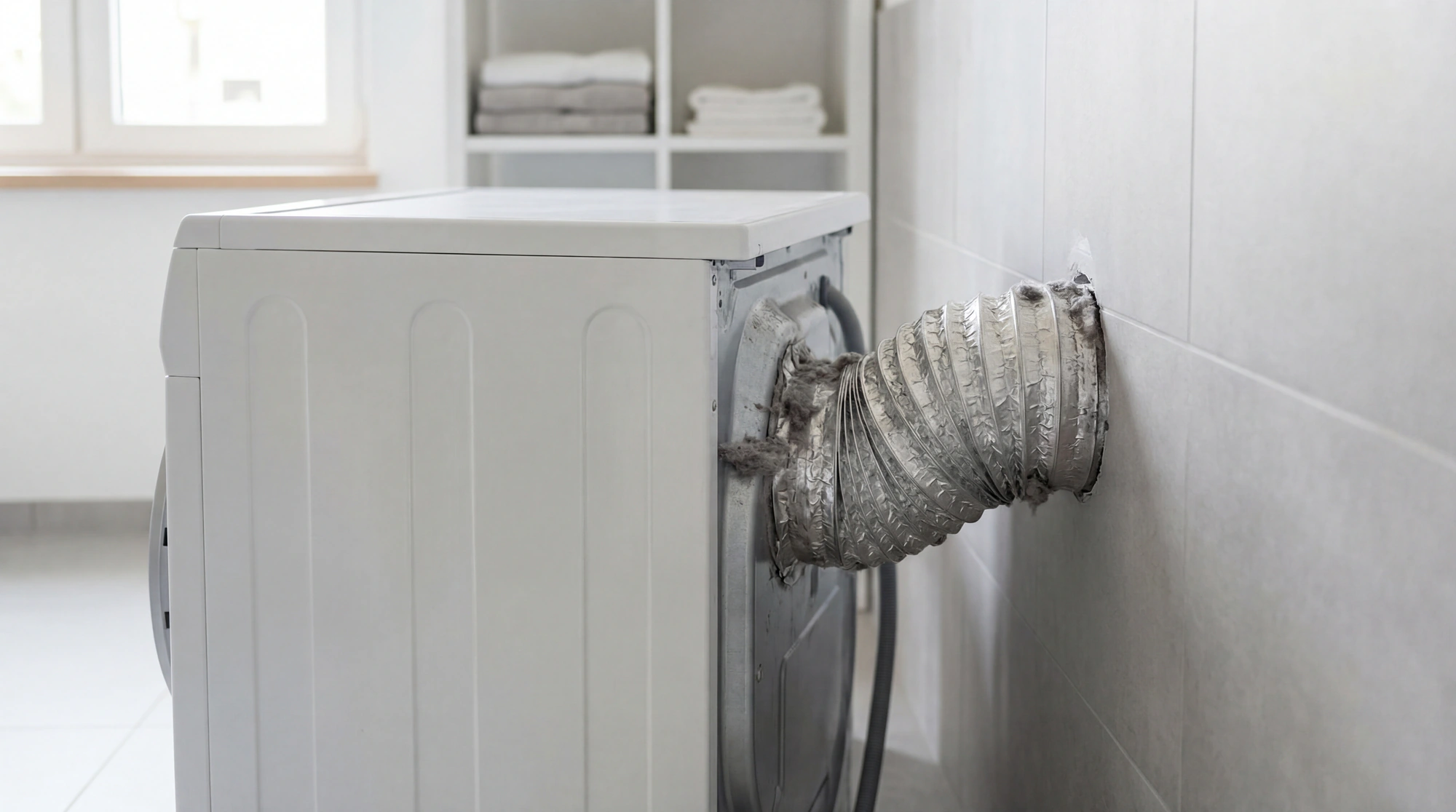
Dryer Vent Repair: Problems & DIY Fixes
Learn to diagnose and fix common dryer vent problems yourself. From crushed ducts to lint buildup - save money with these simple DIY dryer exhaust repairs.

Hot Tub Maintenance: Cleaning Draining & Care Guide
Learn essential hot tub maintenance tips including proper water chemistry, pH levels, and sanitizer requirements to keep your spa clean and safe year-round.