The Switch on Top of Your Ceiling Fan
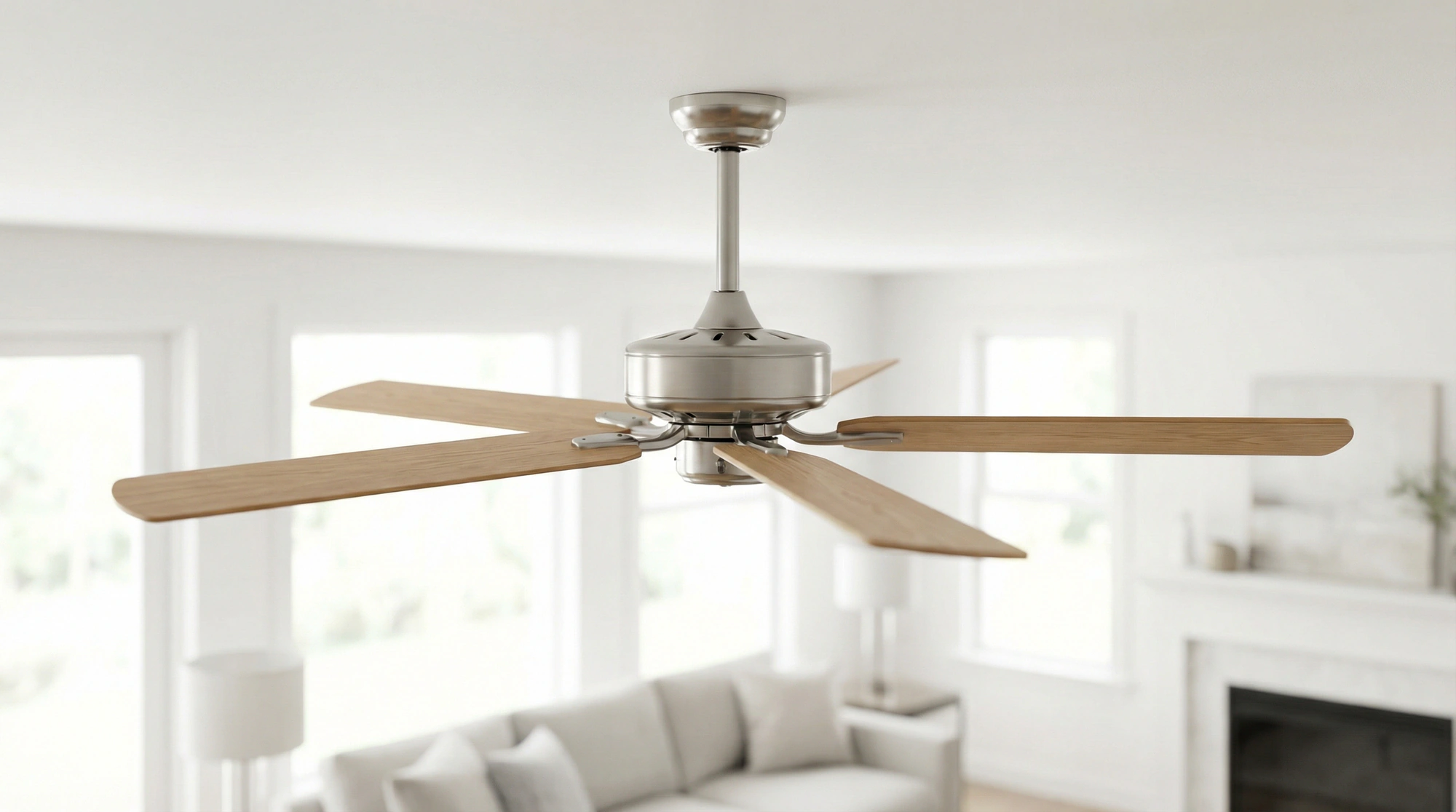
Theres a switch on your ceiling fan. Most people have never touched it. Some people dont even know its there. It reverses the direction the blades spin, and whether you flip it for summer or winter determines whether that fan is actually doing anything useful or just spinning for no reason.
I’ve been in probably a thousand homes over the years and I’d estimate maybe one in ten people know about ceiling fan direction. The rest just turn the fan on when its hot and leave it alone. Which is fine, honestly, if you happen to have it set right. But if you dont, you’re running a motor that’s working against you.
So heres what you need to know.
Summer: Counterclockwise
In the summer, your ceiling fan needs to spin counterclockwise when you’re looking up at it. This pushes air straight down, creating what people call a wind chill effect. The fan doesnt actually lower the temperature in the room. Not even a little bit. What it does is move air across your skin, and moving air evaporates sweat faster, which makes you feel cooler even though the thermometer reads the same.
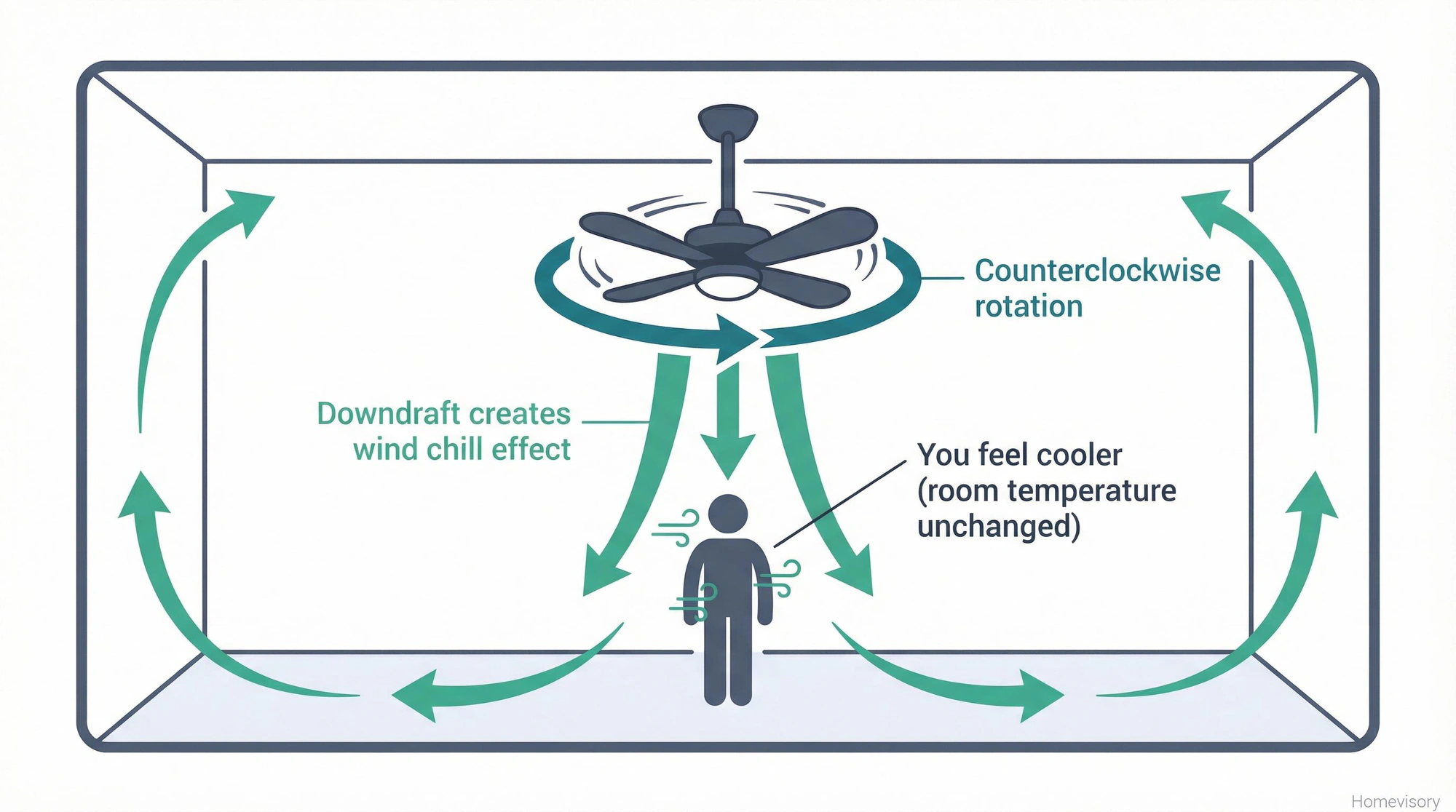
This is the part I probably care too much about but I’ve seen so many people misunderstand this and then complain that their ceiling fan “doesn’t work.” The fan is working fine. You’re just expecting it to be an air conditioner when it’s actually just moving air around. The Department of Energy is clear about this: ceiling fans cool people, not rooms. The benefit is that you can raise your thermostat by about 4°F without feeling any less comfortable because the moving air compensates. Thats where the energy savings come from. Not from the fan itself being some kind of cooling device. From the fact that your AC doesn’t have to work as hard because you’re okay with 76 instead of 72.
Research from the Florida Solar Energy Center found that for every 1°F you raise your thermostat, you cut cooling energy use by almost 10-15%. So that 4 degree bump from using a ceiling fan correctly could mean 40-60% less work for your air conditioner. But here’s the thing they also found, if you run your fans without adjusting the thermostat at all, you might actually increase your energy use. The fan motor draws power. If you’re not offsetting that by letting your AC take a break, you’re just adding load.
My dad Curtis worked in a factory in Atlanta in the 80s before they had good climate control in those buildings. He used to say you cant fight the heat, you have to work with it. Big industrial fans everywhere, guys would position themselves to catch the breeze during breaks. Nobody expected the fans to make the building cold. They just wanted to feel less miserable. Same principle.
Which way should a ceiling fan turn in the summer? Counterclockwise. Every time. Stand under it and you should feel air pushing down on you. If you dont feel anything, its probably spinning the wrong way.
The Switch
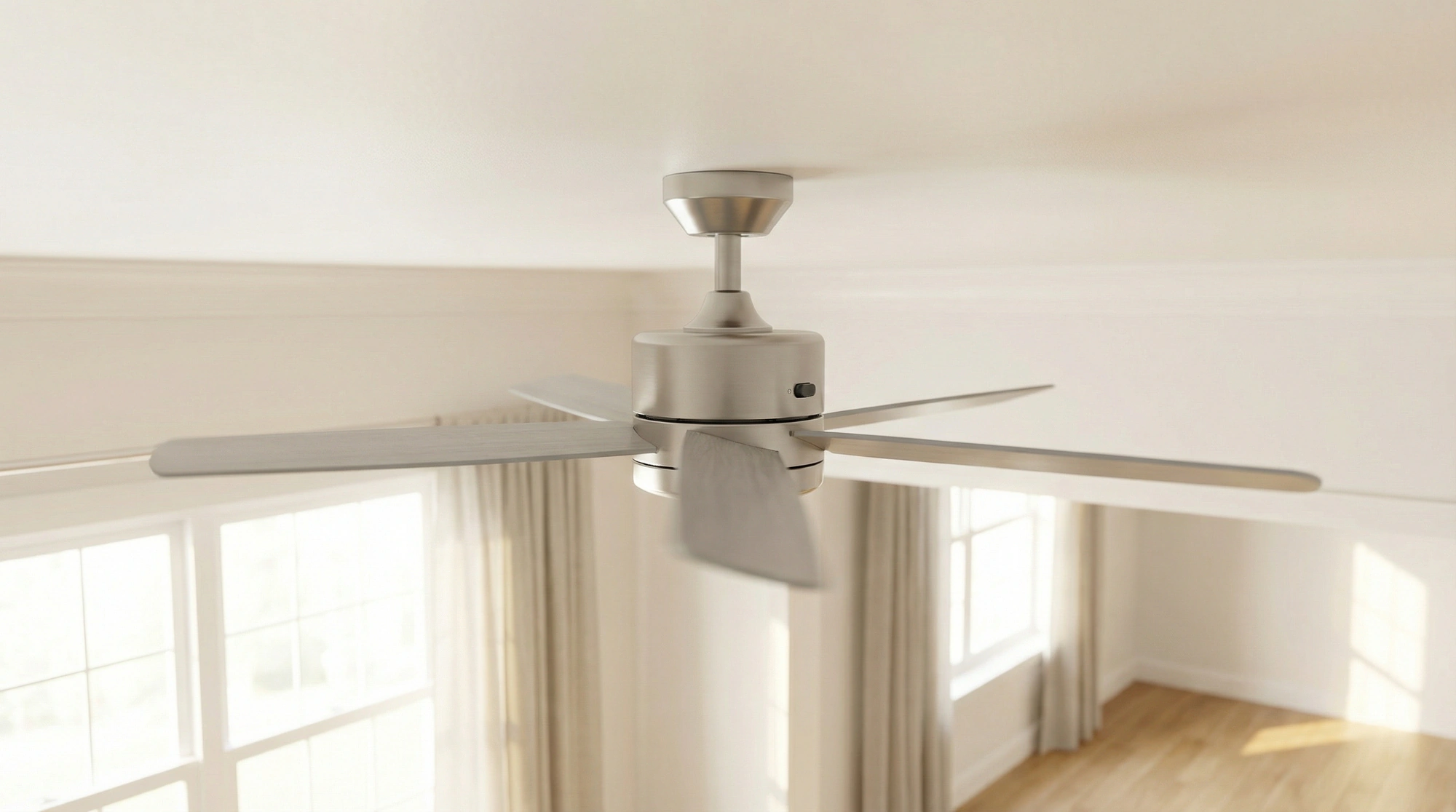
Most ceiling fans have a small switch on the motor housing. Sometimes its on the side, sometimes you have to look for it. Turn the fan off before you flip it. I shouldn’t have to say that but I’m going to anyway because I once watched a guy try to flip the switch while the blades were spinning and he caught one right across the knuckles. Not hard enough to break anything but hard enough that he felt stupid for about a week.
I’m not getting into the engineering of how the motor reverses. It just does. Theres a switch. Flip it. The blades will start spinning the other direction.
Some newer fans have remotes with a button for this. Same idea.
Winter: Clockwise
When it gets cold, you flip that switch so the fan spins clockwise at low speed. This pulls air up instead of pushing it down. Why would you want that? Because heat rises and pools at the ceiling. In a room with high ceilings especially, you can have a situation where all your expensive heated air is hanging out eight feet above your head doing nothing useful while you’re cold on the couch.
Running the fan clockwise on low creates a gentle updraft that pushes that warm air along the ceiling and down the walls. You don’t feel a breeze. You dont get the wind chill effect. You just redistribute heat that was already in the room. The University of Florida IFAS Extension confirms this works for most ceiling fans during winter months. Forcing warm air near the ceiling down into the living space.
The low speed part matters. You dont want to create a breeze in winter. That would make you feel colder, which defeats the entire point. Just enough air movement to circulate the heat. If you can feel the fan running while you’re sitting under it, turn it down.
Industry estimates suggest you can save up to 15% on heating costs in winter by using your ceiling fans this way. That number depends on your ceiling height and how bad your heat stratification is, but its not nothing.
The Ceiling Fan Incident
Speaking of ceiling fans. Back in 2003 I installed a ceiling fan for a client, this was before Homevisory when I was doing renovations, and I didnt check whether the electrical box was rated for a fan. Junction boxes that are fine for a light fixture arent necessarily fine for something with rotating mass and vibration. I knew this. I just didn’t think about it.
The fan tore out of the ceiling at 2:47 in the morning. Crashed onto the bed. Nobody got hurt, thankfully, but the clients cat was in the room and that cat was never the same. Just psychologically destroyed by the experience. I paid for the drywall repair, the new fan, the new fan-rated box, and a vet visit that the client called a “pet trauma consultation.” I don’t know what that cost but I paid it.
Richard was a baby then. I remember driving home from that job, the first time I went to assess the damage, and thinking about how I had a newborn at home and I just installed something that could have fallen on someone. Because I was in a hurry. Because I didnt want to go back to the hardware store for the right box.
There’s a lesson there about shortcuts but I’ve told that story before. The point is I think about ceiling fans differently than most people. I think about the weight of them. The fact that they’re spinning above where you sleep. Anyway.
Which Direction Is Which
This confuses people so let me be specific.
Counterclockwise in summer means if you’re standing under the fan looking up, the blades are rotating the same direction as if you were unscrewing a bottle cap. Left to right across the top of the rotation.
Clockwise in winter means right to left across the top.
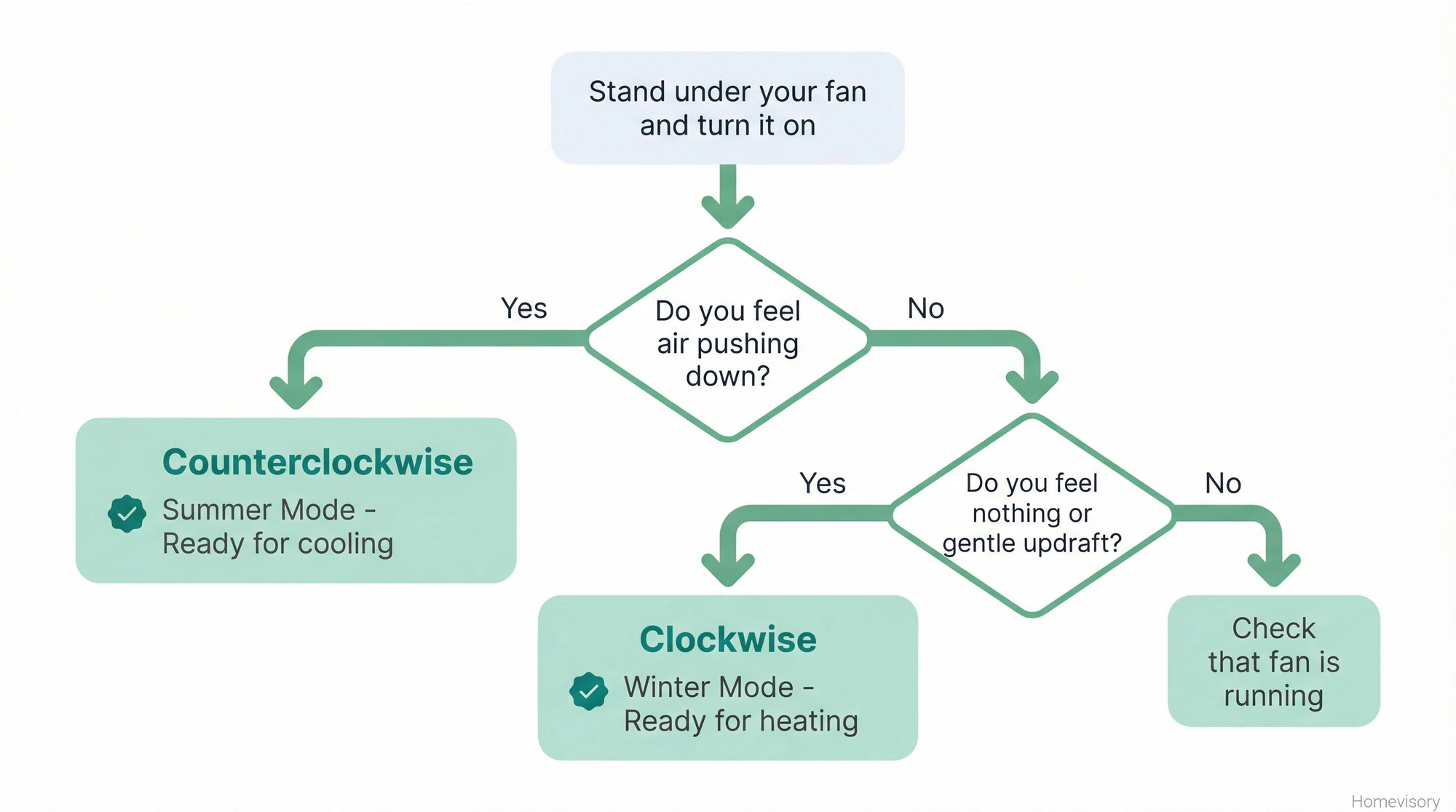
If you cant tell by looking, turn it on and stand under it. Feel air pushing down? Thats counterclockwise, thats summer mode. Feel nothing or a very gentle updraft? Clockwise, winter mode.
Whatever. Its not complicated once you feel it.
The Real Energy Savings
About 80 million American households have at least one ceiling fan. Most of them are not being used optimally. Either the direction is wrong for the season, or the fan is running in empty rooms, or people arent adjusting their thermostats to actually capture the savings.
A ceiling fan cooling an empty room is a waste of electricity. Fans cool people, not spaces. If nobody is in the room, turn it off. I dont care if leaving it on makes you feel like you’re being energy conscious. You’re not.
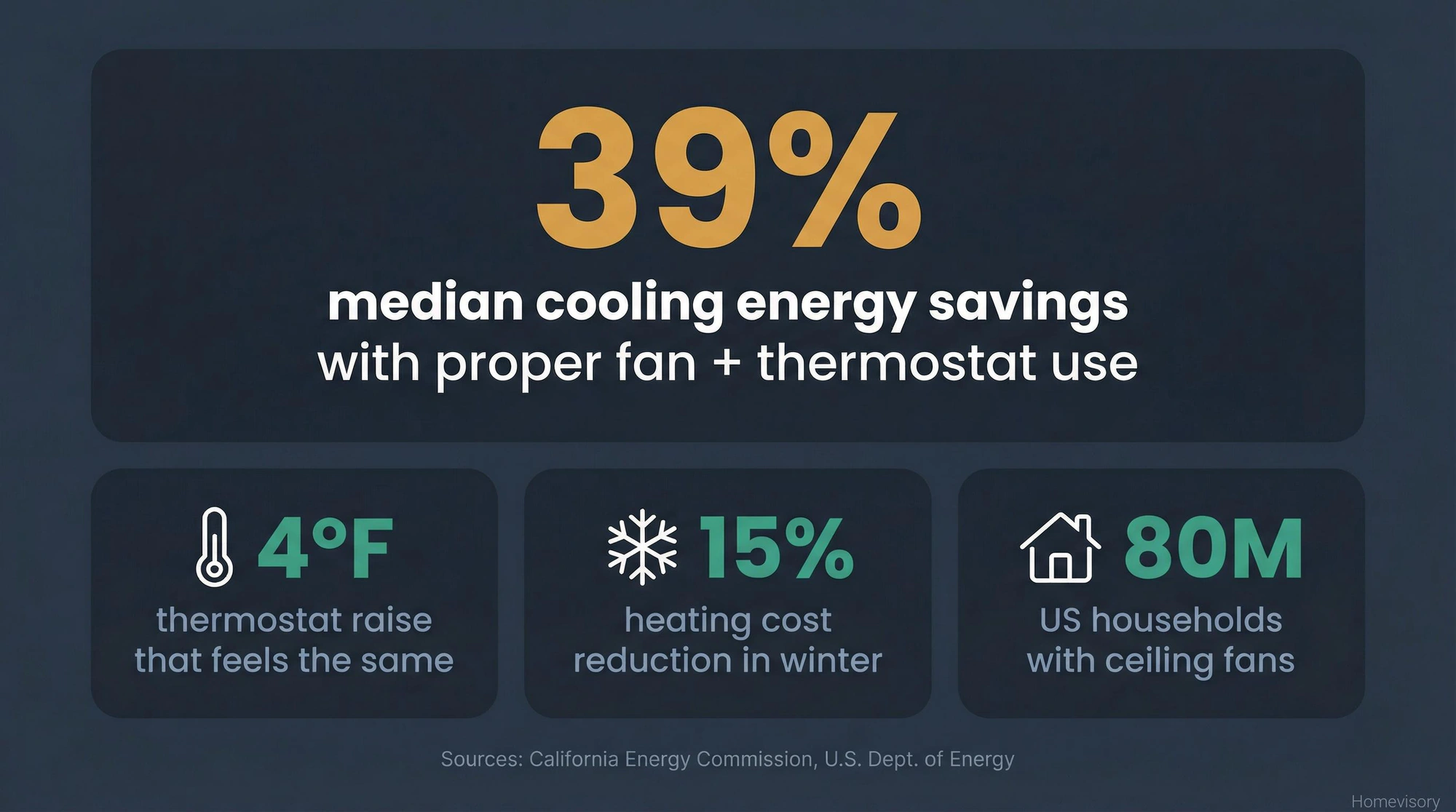
A California Energy Commission study found that when ceiling fans were properly integrated with thermostat adjustments, households saw 39% measured compressor energy savings during cooling season. Some homes hit as high as 71% savings. The median was 15%, which is still real money over a summer.
My dad, this was something totally different, he used to say “dont make future you clean up after present you.” He was talking about putting tools away. But it applies to this. Set the direction right now, in spring and in fall when the seasons change, and future you benefits all season long. Dont leave it for later.
He worked those factory floors for years before things got better. Hot in summer, cold in winter, fans running all the time just to make it bearable. The idea that we can control our environment now with a switch and a thermostat would have seemed like science fiction to the guys he worked with. But we still have to use the tools right or they dont help.
Anyway.
When to Switch
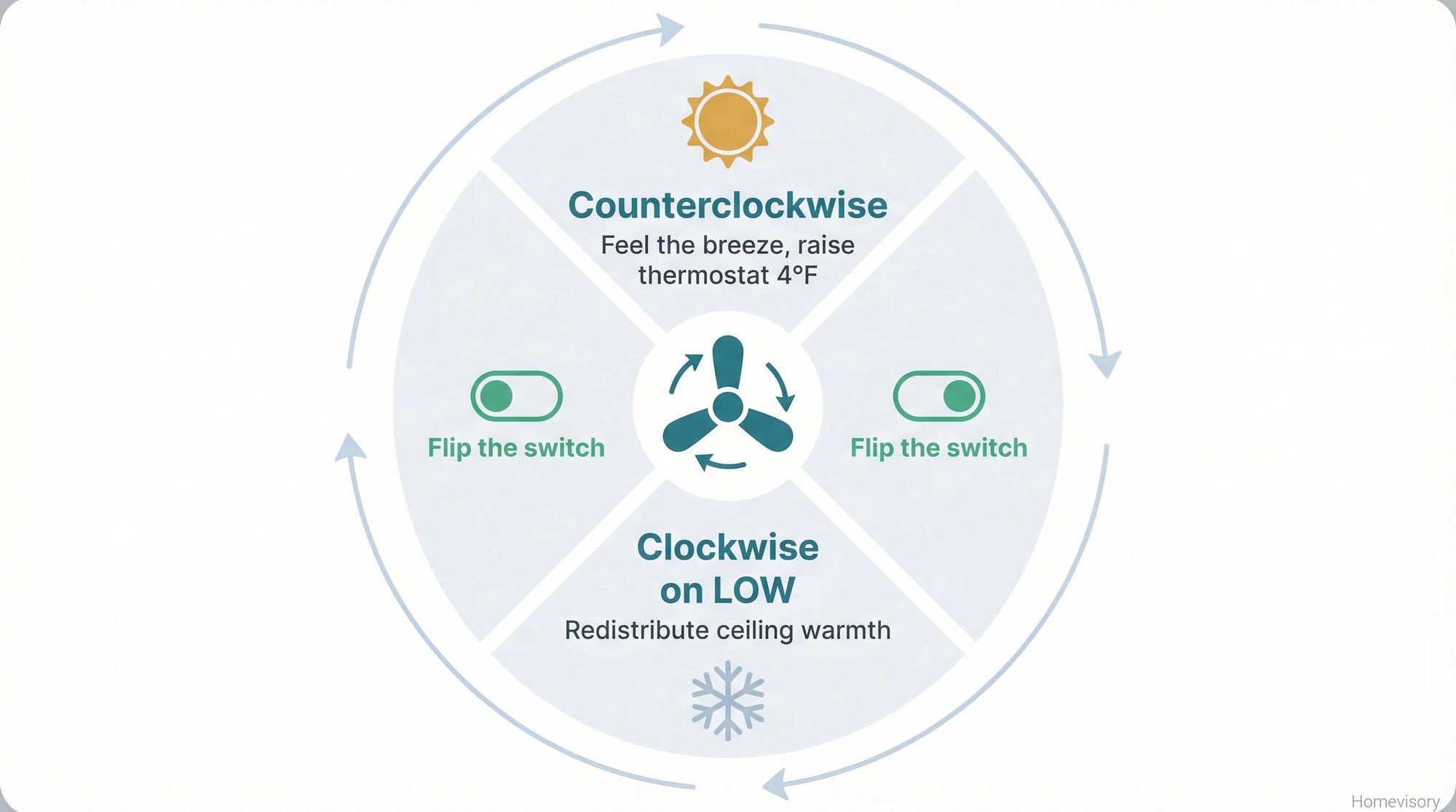
Spring and fall. When you start running your AC for the season, check that your fans are counterclockwise. When you start running heat, flip them to clockwise and turn the speed to low.
Some people set calendar reminders. Some people just wait until they notice it feels wrong. Either approach works as long as you actually do it. I include this on my seasonal home maintenance checklist so it happens automatically with everything else.
Homevisory can remind you to check your ceiling fan direction twice a year as part of your seasonal maintenance schedule. Thats what we do here at Homevisory, we keep track of this stuff so you dont have to remember it yourself. You can sign up free with our Homevisory home task manager and let the system tell you when its time to flip that switch.
Blade Pitch and Fan Height
Fan blades have a pitch angle, usually between 10 and 15 degrees. Steeper pitch moves more air but requires more motor power. I’m not going to tell you to measure your blade pitch. Moving on.
Height matters more. Fans should be installed seven to nine feet from the floor. Lower than seven feet and someone tall might get hit by a blade. Higher than nine feet and the air movement doesnt reach people effectively. If your ceilings are twelve feet tall, the fan helps more in winter mode (redistributing heat) than summer mode (the downdraft dissipates before it reaches you).
Multiple Fans
Big rooms sometimes have two ceiling fans. Set them both the same direction. If one is counterclockwise and one is clockwise youre just creating chaos.
In rooms with high ceilings and fans mounted at different heights, same rule applies. All counterclockwise in summer. All clockwise on low in winter.
New Fans vs Old Fans
ENERGY STAR certified ceiling fans are up to 60% more efficient than conventional models. If your fan is from 1995, a new one might pay for itself in energy savings over a few years. Especially if you run it a lot.
But I’m not going to tell you to replace a working fan just because newer ones are more efficient. If the motor runs, if the direction switch works, if the blades are balanced and it doesnt wobble, keep using it. If it does wobble, check the mounting hardware first, then balance it if needed. Check the direction. Thats the free improvement.
Two things will save you money: setting your ceiling fan direction right for the season, and adjusting your thermostat to take advantage of it. Counterclockwise in summer, push the air down, feel the breeze, raise the thermostat a few degrees. Clockwise on low in winter, redistribute the warm air, keep your heating system from working overtime.
The switch is right there on the fan. Most people have just never flipped it.