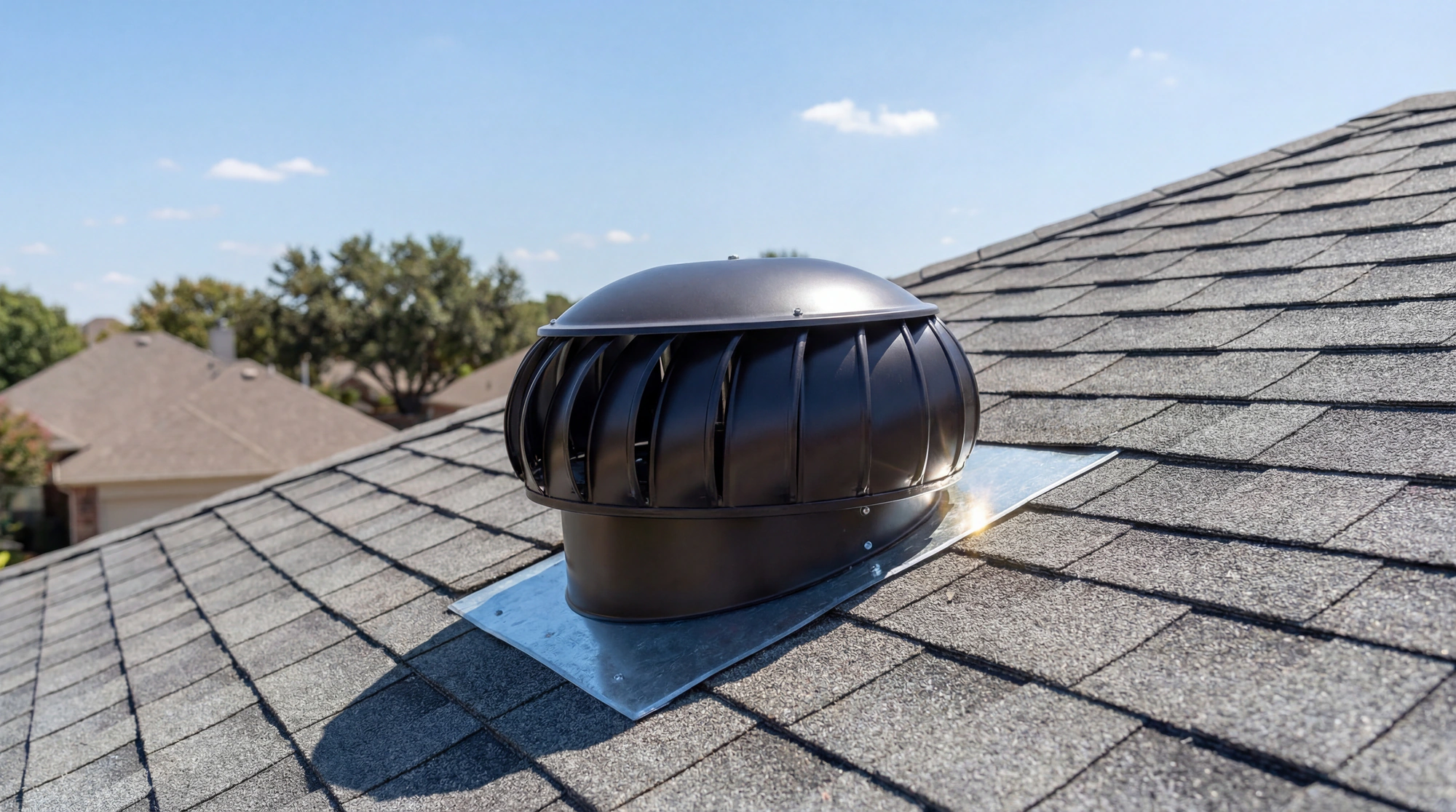
What an Attic Fan Actually Does
Most people have a vague idea that an attic fan moves hot air out of their attic. Thats correct but its also missing the point.
Your attic in summer can hit 150 degrees. Sometimes higher. All that heat sits up there radiating down into your ceiling, making your AC work harder, and generally turning the top floor of your house into a sweat lodge. An attic exhaust fan pulls that hot air out and replaces it with cooler outside air. Simple concept.
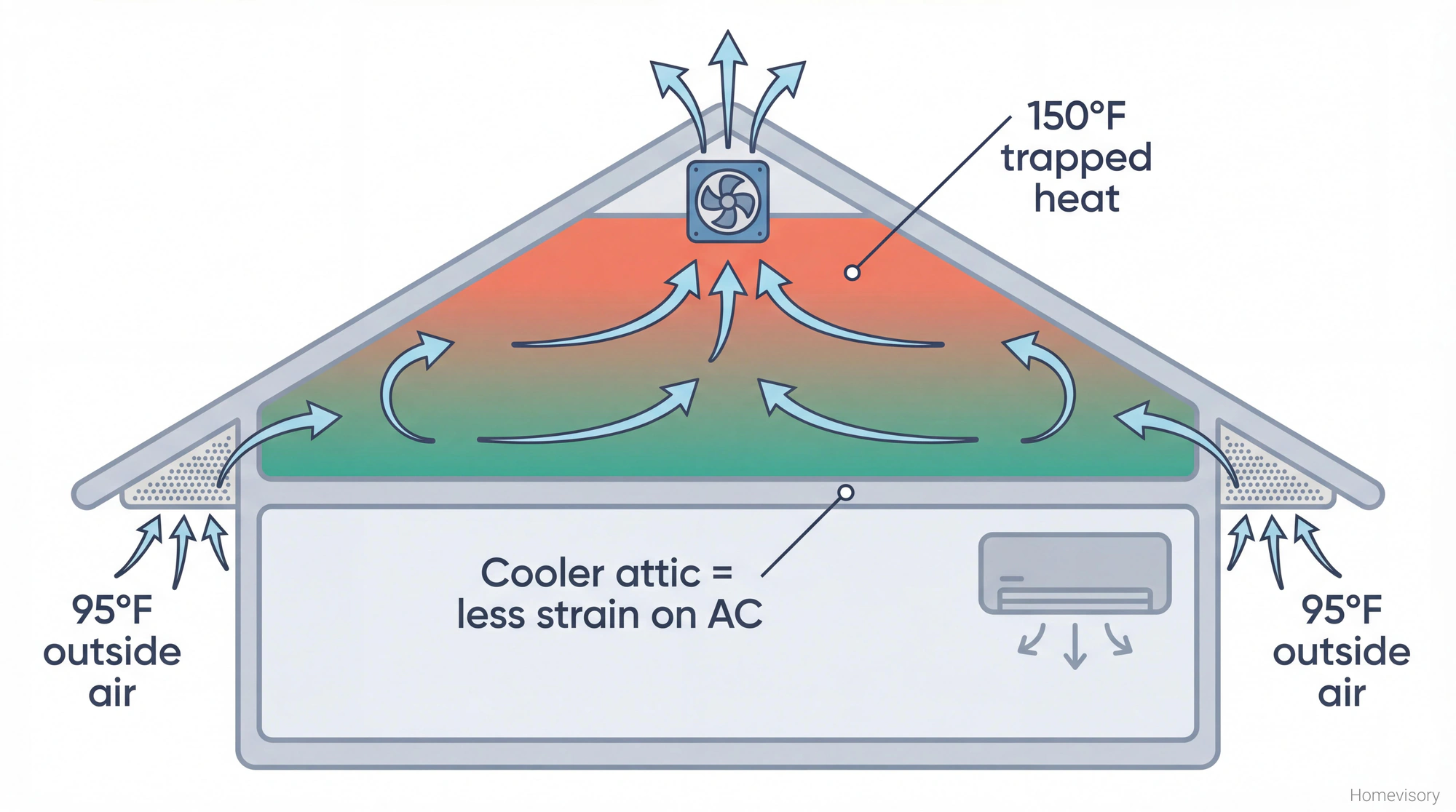
The part people mess up is when they think the fan cools the attic. It doesn’t cool anything. It exchanges air. If its 95 degrees outside, your attic fan is going to make your attic 95 degrees instead of 150 degrees. Thats the win. Youre not getting air conditioning up there.
I’ve been installing and repairing attic vent fans since the early 90s when I was doing commercial work in Texas, and the number of people who expect miracles from a $300 fan is remarkable. Its a fan. It moves air. It does that very well. It does not do magic.
Types of Attic Fans
Three main types youre going to encounter.
Roof-mounted: Cuts through your roof decking, sits on top, pulls air straight up and out. Most common. Most effective for most situations.
Gable-mounted: Mounts in the triangular wall at the end of your roof, the gable. Pushes air horizontally out. Easier to install because youre not cutting through roofing material, just siding.
Solar: Has a solar panel, runs during the day without electricity costs. Im not getting into solar here because the installation is different enough that it deserves its own article and honestly I don’t install them myself anymore. If you want solar, call someone who specializes.
For most homeowners, roof-mounted or gable-mounted is the decision. Roof-mounted moves more air. Gable-mounted is easier to access for attic fan repair later. I slightly prefer roof-mounted but I’ve installed hundreds of both and both work.
Attic Fan Installation Cost
This is where everyone wants a number and I’ll give you one but you have to understand the range is wide.
For a standard attic exhaust fan installation, youre looking at $300-800 for the unit itself depending on CFM rating and brand, plus $200-500 for installation if youre hiring someone. So total attic fan installation cost is usually $500-1300 for a professional job.
If its a gable mount and you already have a gable vent opening the right size, installation is faster and cheaper, maybe $150-250 labor. If its a roof mount and someone has to cut through shingles and decking and flash it properly so you dont get leaks, thats more work and more cost.
I did an attic fan installation in Plano back in 1997, this guy had a two-story with cathedral ceilings in parts and a nightmare attic layout, took me most of a day because the access was terrible and I had to navigate around ductwork to get the wiring run. Charged him $400 labor which was a lot in 97 but I earned it. Came down looking like Id been through a car wash of my own sweat. The attic was easily 145 degrees and I was up there for hours. Thats the high end of installation difficulty but it happens. My dad Curtis, when I was a kid in Atlanta, I remember him going up into our attic once to check something, I dont even remember what, and he came down the ladder looking like hed run a marathon in a sauna. His shirt was soaked through. He just stood there breathing for a minute and then said something like I am never doing that in August again. He did it in August again the next year because something else needed checking. Anyway.
If youre handy and comfortable with basic electrical work, attic fan installation is doable as a DIY project. The mechanical part isn’t hard. The electrical part is where most people should stop and call an electrician. Im talking about running a new circuit if needed or tying into existing wiring safely. If you already have a junction box in the attic from a previous fan or for attic lighting, the job gets much simpler.
The Attic Fan Thermostat (This Is Where People Mess Everything Up)
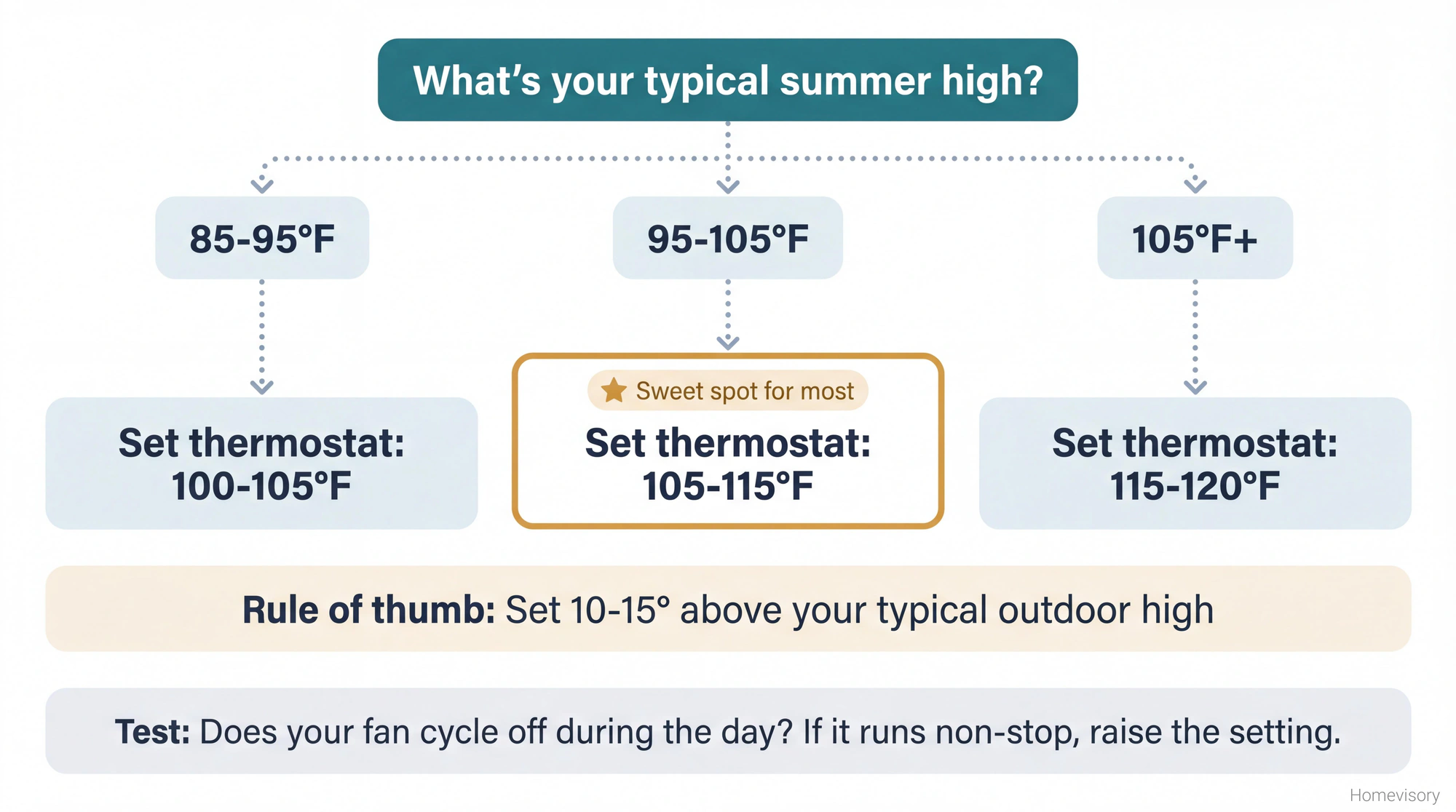
Heres the part I probably care too much about but I’ve seen so many homeowners waste money and wear out their fans because nobody explained this to them. Your attic fan thermostat controls when the fan kicks on and its usually adjustable between about 90 and 130 degrees. Most people set it wrong. Most people set it at the lowest setting, 90 or whatever, thinking thats going to keep their attic as cool as possible and thats technically true but it also means the fan runs constantly during summer months and burns out faster and uses more electricity and if its particularly hot outside youre sometimes pulling in air thats not much cooler than what you’re expelling so the fan is just churning air around accomplishing nothing while wearing out the motor. I set mine at 105. That means when the attic hits 105 the fan kicks on and runs until it drops below that. In Florida summer that fan runs plenty but it gets breaks. At 90 degrees set point it would run from sunrise to midnight without stopping.
Mr. Davis, my woodshop teacher back in Atlanta, used to say let the tool do the work. He was talking about pushing too hard on a saw or forcing a chisel instead of letting the sharp edge do what it was designed to do. I think about that with attic fans. Let the fan do the work. Dont make it work all day long trying to achieve the impossible. Set a reasonable target and let it cycle on and off.
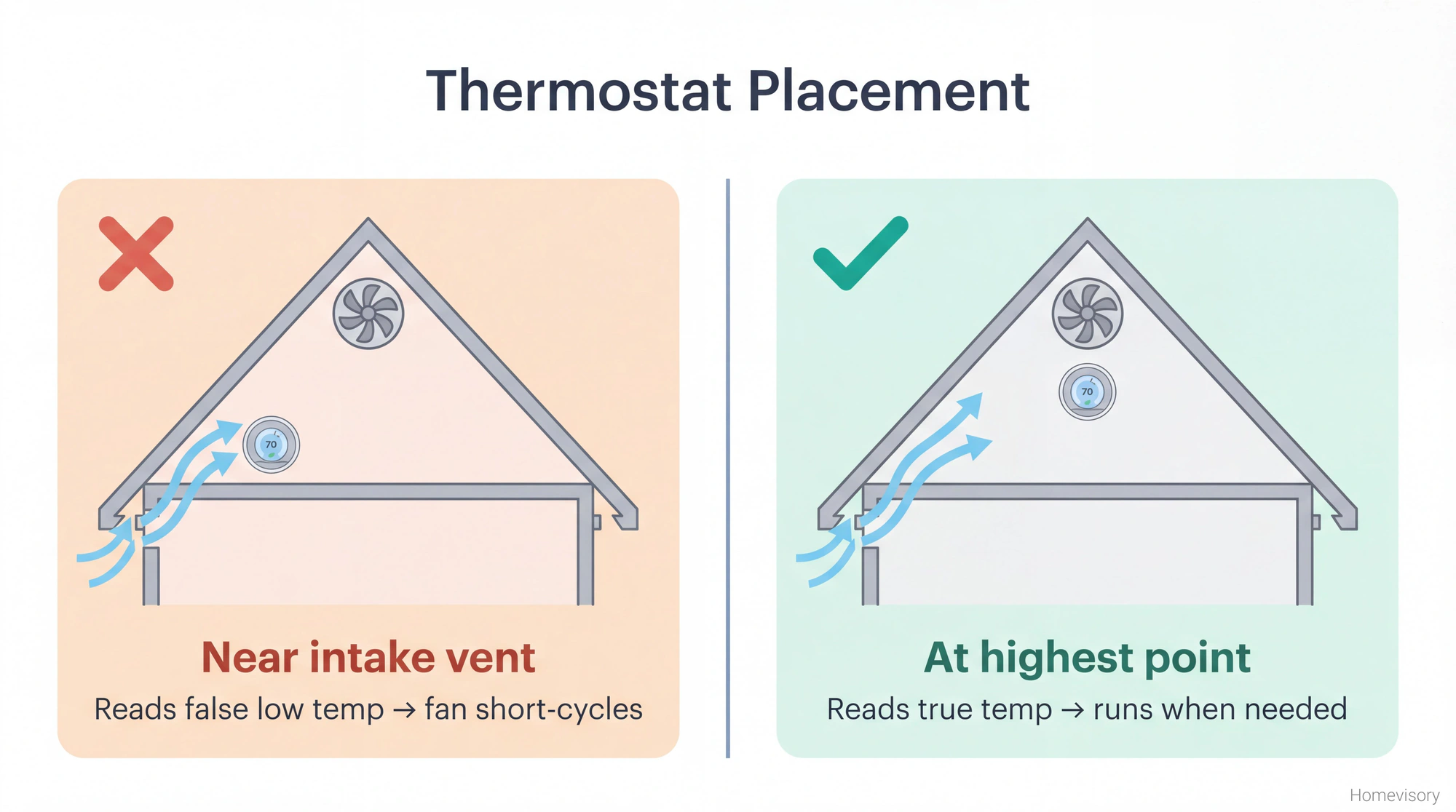
The other thing about the attic fan thermostat is location. It needs to be in the hottest part of the attic, which is usually the highest point away from any soffit vents. If you mount the thermostat near an intake vent where cooler air is coming in, it wont read true attic temperature and the fan will short cycle.
Some newer units have a humidistat built in too. That kicks the fan on based on humidity, not just heat. Useful in climates like Florida where moisture in the attic is as much a problem as heat. I have one with a humidistat. Set it at 70% humidity as the trigger.
Attic Fan Repair
Motors burn out. Thats the main failure.
You hear the fan try to start and it hums but doesnt spin, or it spins slowly and makes grinding noises, or it just sits there dead. Ninety percent of the time its the motor.
Heres my honest take on attic fan repair: if the motor is shot, replace the unit. Done. You can buy a replacement motor for $75-150 and spend an afternoon in a 130 degree attic swapping it out, or you can buy a whole new fan for $200-350 and have fresh bearings and a new thermostat and a warranty. The math doesnt work for motor replacement unless you have some high-end unit that costs $600+.
Other things that fail:
Thermostat: If the fan never kicks on even when the attic is clearly hot, could be the thermostat. You can test this by bypassing it temporarily, just connecting the wires directly so the fan should run constantly. If it runs, your thermostat is bad. Replacement thermostats are $20-40. Thats a repair worth doing.
Wiring: Rodents in attics chew through wires. Ive seen it more times than I can count. Look for damage, look for droppings near the wiring. If Mickey’s been snacking on your electrical, you need to repair the wires and probably address your rodent situation.
Shutter stuck: The shutter louvers on top of the fan, the ones that open when the fan runs and close when it stops, can get stuck from debris or rust or paint. Sometimes you just need to unstick them. Free repair. Very satisfying.
For attic fan repair costs, if you’re hiring someone: a thermostat replacement is probably $100-150 total with labor. A full fan replacement installed runs you back to that $500-1300 range I mentioned earlier. Anything in between, like wiring repair, depends on the scope but figure $150-300 for a service call plus whatever parts.
What CFM Rating Do You Need
Quick math. You want your attic fan to exchange all the air in your attic once every few minutes. Measure your attic square footage, multiply by 0.7 for standard roofs or 0.5 for low pitch roofs, and thats roughly the CFM you need.
1500 square foot attic with normal roof slope: about 1050 CFM. 2000 square foot attic: about 1400 CFM.
Most residential attic exhaust fans are 1000-1600 CFM. Youre probably fine with whatever mid-range unit you pick from the hardware store.
Bigger isnt always better. An oversized fan creates negative pressure in the attic which can pull conditioned air up from your living space through any gaps in your ceiling. Recessed lights, attic hatches that dont seal well, ceiling fans with gaps around the mount. Youre paying to cool air and then sucking it up into the attic and blowing it outside. Get the right size.
Installation Considerations
Soffit vents matter. Your attic fan pulls air out but that air has to come from somewhere. It should come from soffit vents or gable vents, not from your house. If you don’t have adequate intake vents, the fan cant do its job and might actually cause problems.
Basic rule: you want 1 square foot of intake vent area for every 150 square feet of attic space. Most houses have soffit vents running the length of the eaves. Check yours. If they’re painted over or blocked with insulation, clear them before installing an attic vent fan.
Electrical requirements vary by unit but most residential attic fans are 120V and pull 2-4 amps. Not a heavy load. Often can share a circuit with attic lighting if you have it. Dedicated circuit is better if youre running new wire anyway.
Whatever. Just get an electrician involved if you’re not confident. This isnt the place to learn electrical work.
Does It Actually Save Money
Yes. Usually.
A well-functioning attic exhaust fan can drop your attic temperature by 30-50 degrees during peak heat. That means your ceiling isnt radiating stored heat down into your living space and your AC doesnt have to work as hard to maintain temperature.
Heres the honest truth though. Research from the Florida Solar Energy Center found that powered attic fans often consume more electricity than they save in cooling costs. The economics depend heavily on your thermostat settings, which is why I spent so much time on that section above. If your fan runs constantly at a 90-degree setpoint, youre probably losing money. If its set properly at 105-110 degrees and only runs during peak heat, the math can work out differently. In my experience, homeowners who follow the thermostat guidance and have adequate soffit vents see benefits, but I wont pretend the research is universally positive on powered attic ventilation.
The fan itself uses maybe $2-5 per month in electricity during heavy use months. If your cooling bill drops $20-40 per month in summer, youre ahead. And if you’re considering upgrading to a more efficient cooling system altogether, our heat pump installation cost guide breaks down what to expect.
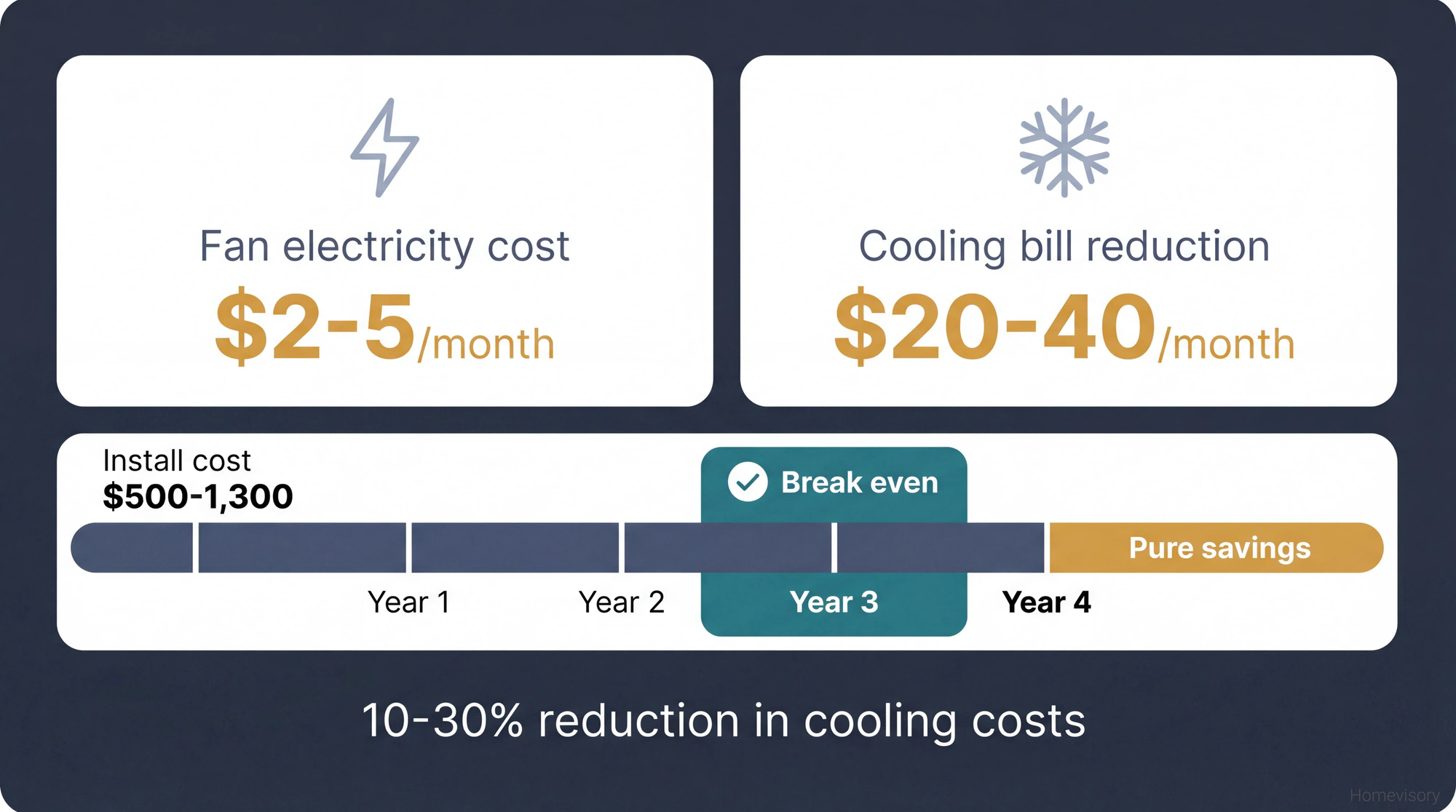
Payback period on the full attic fan installation cost is usually 2-4 years depending on your climate and electricity rates. After that its pure savings assuming nothing breaks.
When to Use Homevisory
This is the kind of task that slips through the cracks. You install an attic fan, it runs, you forget about it for years until it dies. Meanwhile the thermostat might need adjusting as seasons change, the shutter louvers might need cleaning, the motor might be starting to strain in ways you cant hear from inside the house.
Thats what we built Homevisory for. The task manager reminds you to check your attic fan at the right intervals. Inspect the shutter before summer kicks in. Test the thermostat annually. Listen for motor strain. Small stuff that prevents the big repair bill or the surprise failure in the middle of July when every HVAC tech in your area is booked solid.
Sign up is free. We’ll help you stay ahead of this stuff instead of reacting to it when something breaks. Thats what we do here at Homevisory.