The Dial Looks Intimidating Until It Doesn’t
A multimeter is one of those tools that sits in the drawer because the dial has too many symbols and nobody wants to admit they dont know what half of them mean. I get it. I avoided mine for years. Bought it, put it in the garage, used it maybe twice, then forgot about it because every time I picked it up I had to look up what the symbols meant again.
Heres the thing about how to use a multimeter though. You probably only need three functions. Maybe two. The rest of that dial is for electricians and people who fix circuit boards for a living. You’re a homeowner. You need to check if something has power, if a fuse is blown, or if a wire is broken. Thats it.
So thats what I’m going to teach you.
What a Multimeter Actually Does
A multimeter measures electrical stuff. Voltage, current, resistance, continuity. The name literally means “multiple meters” because it used to be you needed separate tools for each measurement. Now its all in one device with a dial that makes people nervous.
The dial has symbols. The multimeter symbols look like hieroglyphics until someone explains them once and then they’re obvious forever. Here’s what you actually need to know:
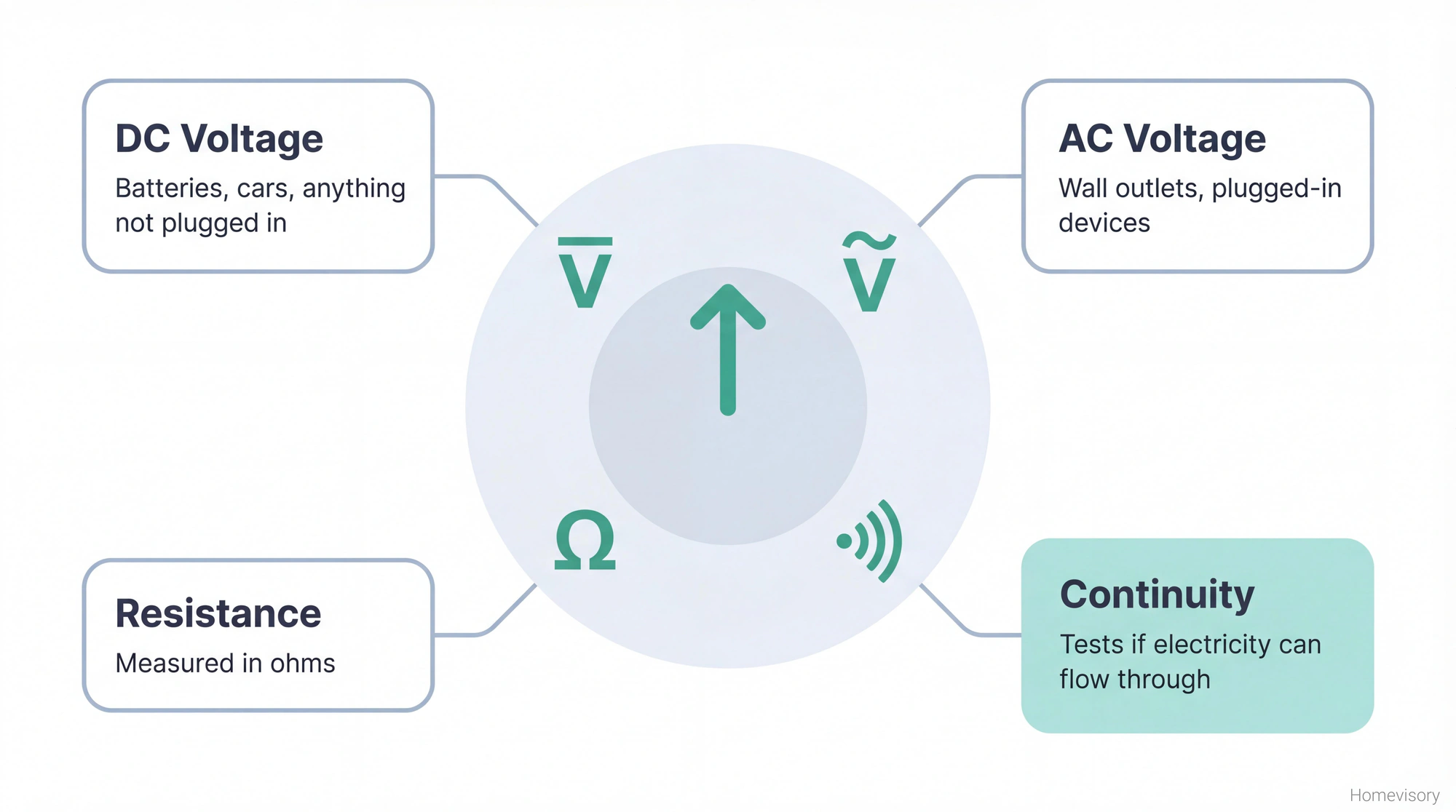
V with a straight line above it — DC voltage. Batteries, cars, most stuff in your house thats not plugged into the wall.
V with a wavy line above it — AC voltage. Anything plugged into an outlet. Your wall power is AC.
Ω (omega symbol) — Resistance. Measured in ohms. Useful sometimes.
The continuity symbol on multimeter looks like a little sound wave or a dot with curved lines coming off it, kind of like a WiFi symbol rotated. Some meters have a diode symbol next to it. This tests if electricity can flow through something. Its my favorite function and I’ll explain why.
A — Current. Amperage. You probably dont need this. More on that later.
Best Multimeter for Homeowners
People ask me about the best multimeter all the time and I’m going to save you money right now. You dont need a $200 Fluke. You dont need a $150 Klein. Those are for professionals who use them eight hours a day and need accuracy to three decimal places.
You need a $25-40 meter from a decent brand. I use a Klein MM400 which was around $35. The Innova 3320 is fine. The AstroAI ones on Amazon are fine for basic stuff.
My dad used to say, about something totally different, he used to say “the tool doesnt make the craftsman, the craftsman makes the tool.” He was talking about wrenches I think, or maybe something at the factory. But it applies. A cheap multimeter in the hands of someone who knows what they’re doing beats an expensive one sitting in a drawer because the owner is intimidated.
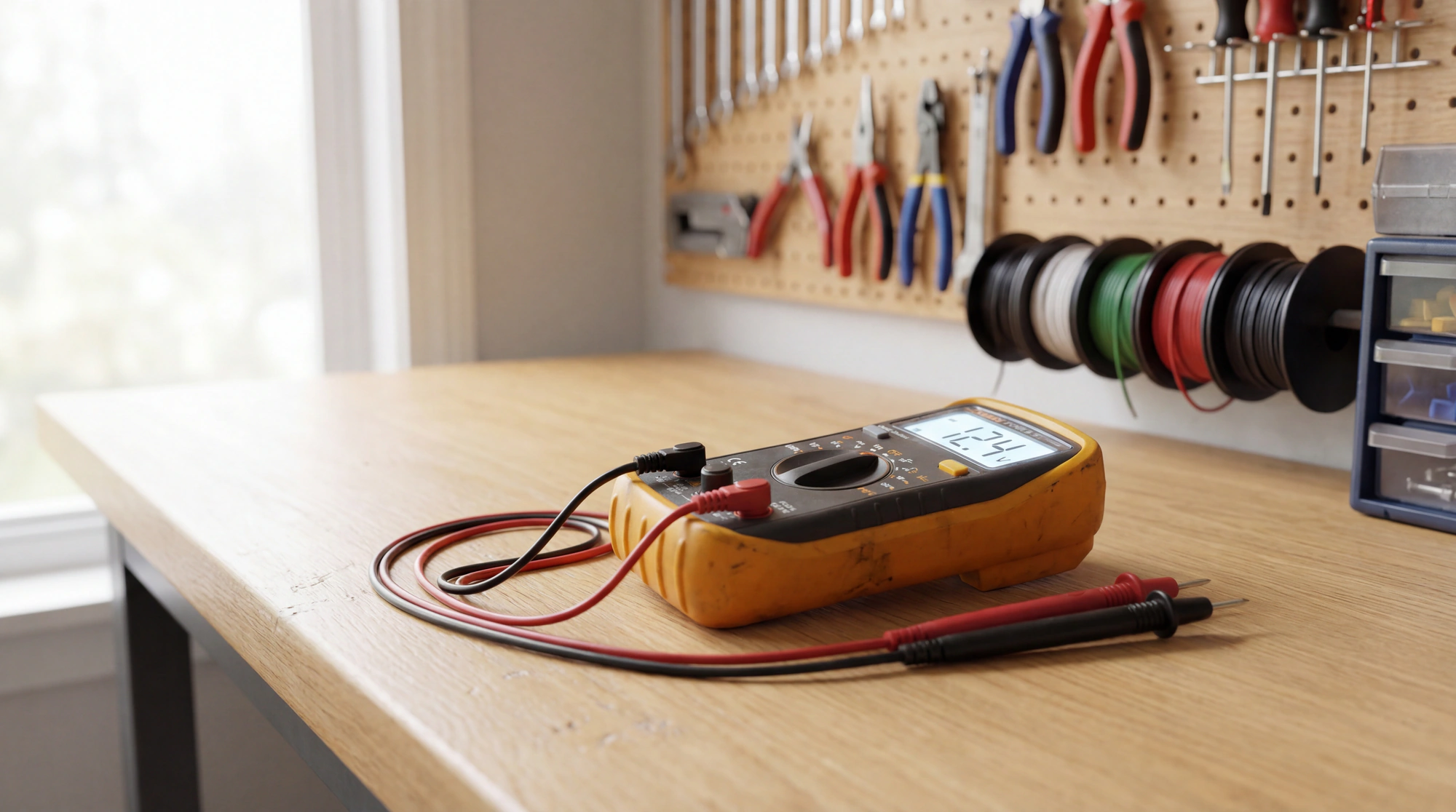
I will say this though. I bought a $9 multimeter from Harbor Freight once, probably 2008 or 2009, and that thing gave me wrong readings for months before I realized it. Tested a battery that showed 12.4 volts and the battery was actually dead. Tested an outlet that showed 118 volts and it was actually 95 because of a loose connection. I didnt know the meter was wrong because I trusted it. Threw it away eventually. Buy something in the $25-40 range from a real brand. Thats the sweet spot.
How to Use Multimeter to Check Voltage
This is what most people need. You want to know if something has power.
Put the black probe in the COM port. Thats the common ground. It stays there basically forever.
Put the red probe in the port marked V (sometimes it says VΩ or VΩmA, same thing for voltage).
Turn the dial to voltage. DC for batteries and car stuff, AC for outlets and anything plugged in. If you’re not sure, AC outlets will show around 120 volts, DC batteries show whatever the battery is rated for.
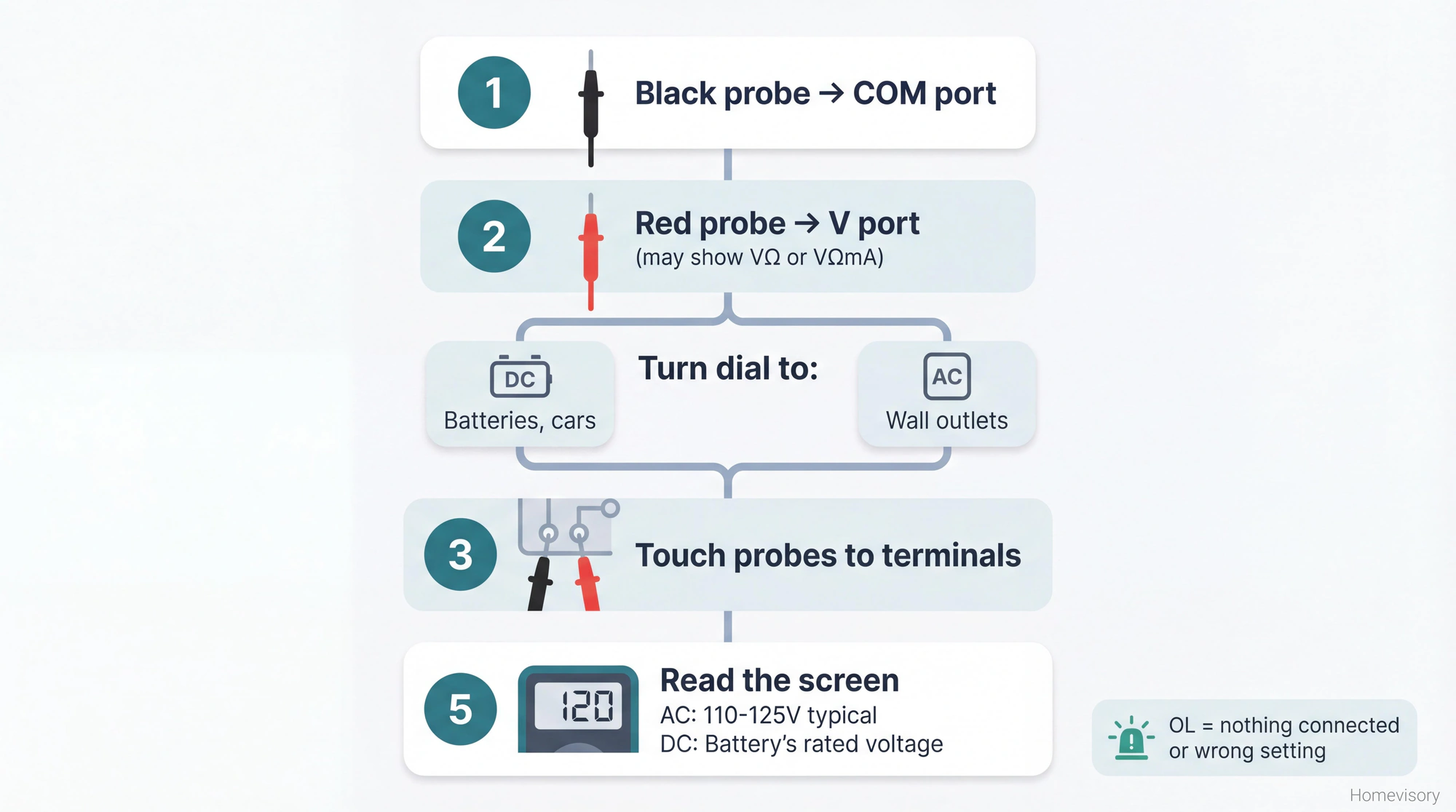
Touch the probes to the thing. For a battery, black to negative, red to positive. For an outlet, stick the probes in the slots. The smaller slot is hot, the larger slot is neutral, but honestly for checking if an outlet works you can just stick them in either way and see if you get a reading.
The screen shows the voltage.
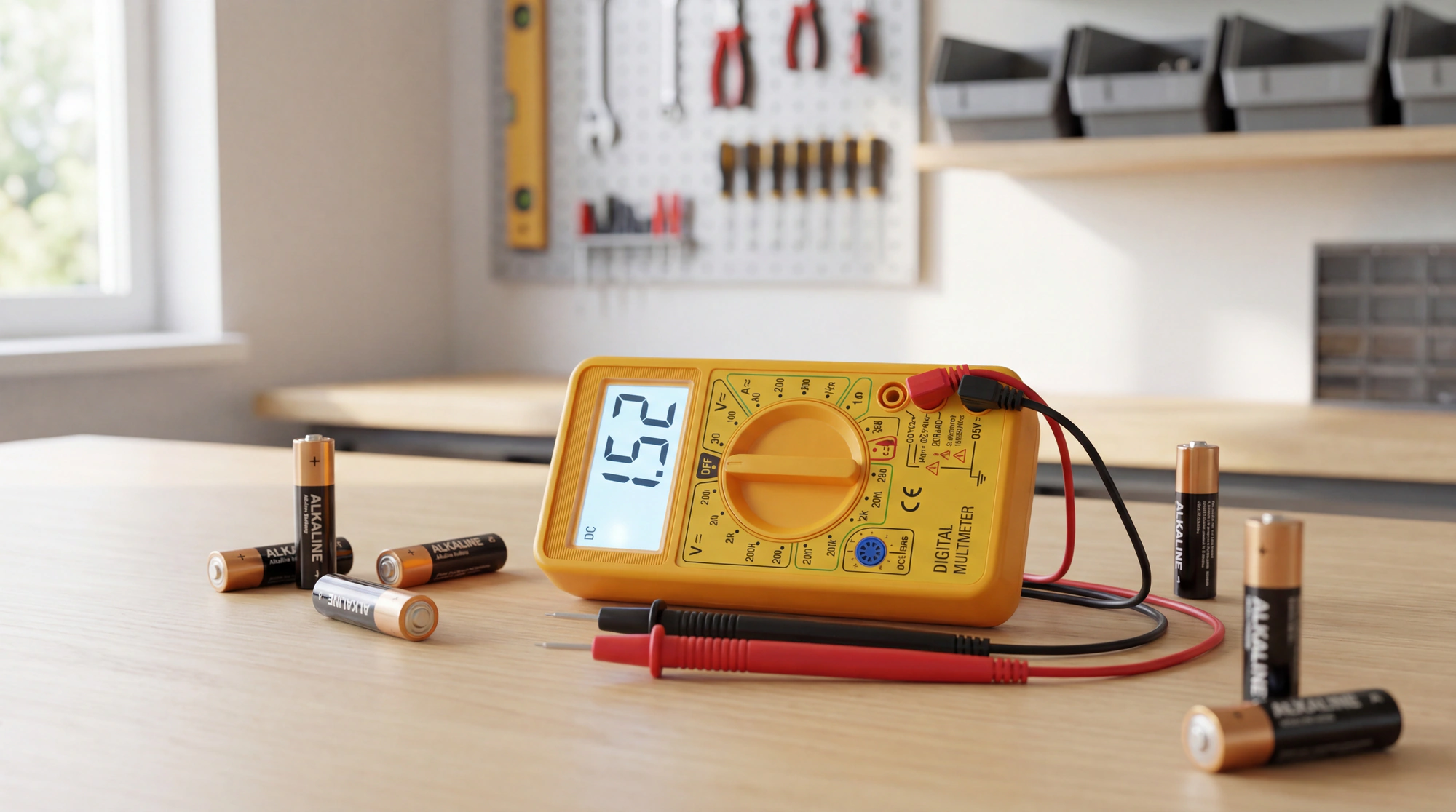
Thats it. Thats how to use a multimeter for voltage. If you’re checking a 9-volt battery and it shows 9.2 volts, battery is good. Shows 7 volts, battery is dying. Shows 4 volts, its dead.
For outlets, you should see somewhere between 110-125 volts. 120 is typical. If you see significantly less, or nothing, you have a problem.
What does OL mean on a multimeter. You’ll see this. OL means “overload” or “open loop” depending on the context. If you’re testing voltage and you see OL, either nothing is connected or you’re on the wrong setting. If you’re testing continuity and you see OL, it means the circuit is open, meaning no continuity, meaning the thing you’re testing is broken or disconnected. We’ll get to that.
The First Time I Actually Used One
Mr. Davis in Atlanta, the woodshop teacher I’ve mentioned before, he also taught a basic electrical unit one semester. This was before everything was specialized. Shop teachers taught whatever needed teaching.
He had us check if the wall outlets in the shop were live before we plugged anything in. This was after some incident the year before where a student got shocked because an outlet was wired wrong. He handed me this old analog multimeter, the kind with the needle that swings, and told me to check the outlet by his desk.
I stuck the probes in and the needle swung to about 115 volts and he said “good, now you know its live” and that was it. That was the whole lesson. Five seconds. But I remember he said something after that about always checking before you assume. Never trust that a switch is off just because the switch says off. Always check. He was talking about electricity but he was also probably talking about everything else. I think about him sometimes when I’m using a multimeter. He passed in 2012. Anyway.
Continuity Testing Is the Actual Useful Part
This is where I’m going to spend some time because continuity testing is the function most homeowners ignore and its the one that would solve half their problems if they used it.
Continuity means electricity can flow from point A to point B. If there’s continuity, the circuit is complete. If theres no continuity, something is broken, disconnected, corroded, or otherwise interrupted. The continuity symbol on your multimeter is that little sound wave thing or sometimes just a dot with parentheses around it. Turn the dial there.
When you touch the two probes together, the meter should beep. Thats how you know its working. The beep means “yes, electricity can flow between these two points.” No beep means “no, something is blocking the flow.” Now instead of touching the probes together, touch them to opposite ends of whatever you’re testing.
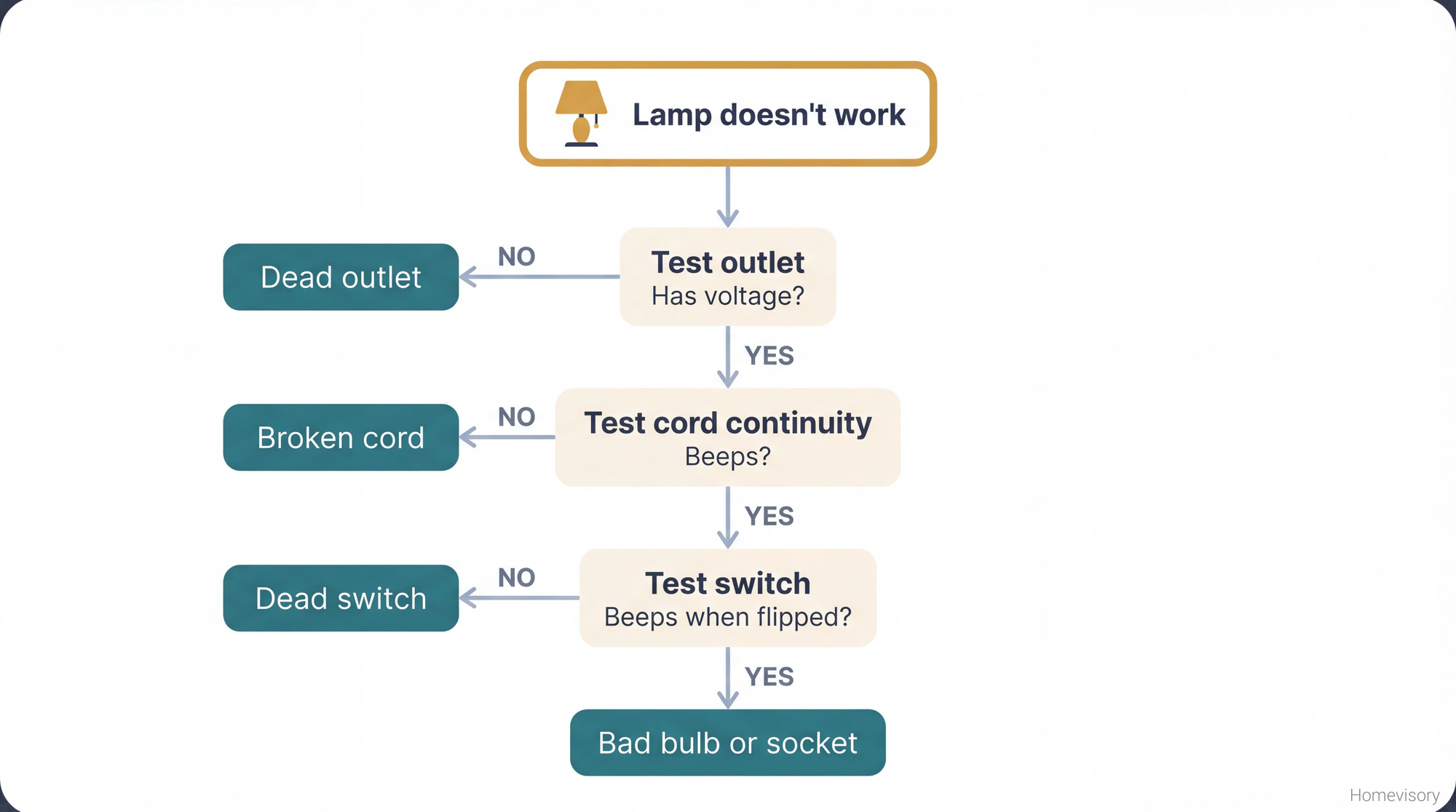
Heres why this matters. You have a lamp that doesnt work. You plug it in, flip the switch, nothing happens. Is it the bulb? The cord? The outlet? The switch? Without a multimeter you’re guessing. You buy a new bulb. Still nothing. You buy a new lamp. Original lamp was fine, outlet was dead.
With a multimeter you check the outlet first. Has voltage? Okay, outlet is fine. Unplug the lamp, set meter to continuity, touch one probe to one prong of the plug and one probe to the corresponding contact inside the lamp socket. Does it beep? Good, that wire is fine. No beep? The cord is broken somewhere inside the insulation where you cant see it. Same thing for the switch, you can test if the switch actually completes the circuit when you flip it or if the switch itself is dead.
I test extension cords this way. I test lamp cords. I test fuses, just put the probes on either end of the fuse and if it beeps the fuse is good, if it shows OL the fuse is blown. I test trailer wiring when the lights arent working. I test doorbell wires. I test speaker wire runs to figure out which wire goes where. I test heating elements in dryers when they stop heating. Continuity testing answers the question “is this thing electrically connected or not” and that question comes up constantly once you start paying attention.
The ceiling fan incident I’ve talked about before, when the fan tore out of the ceiling at 2:47 AM, that was an electrical box problem not a wiring problem. But I’ve had plenty of situations where continuity testing found a broken wire inside a wall or a corroded connection in a junction box that would have taken hours to find otherwise. Touch, beep or no beep, answer.
My mom Shirley would appreciate this kind of troubleshooting. Systematic. Dont guess. Check. She didnt know anything about electrical work but she knew about not wasting time and money on the wrong thing.
Resistance Measurement
The Ω symbol. Resistance is measured in ohms. This tells you how much a component resists electrical flow.
Honestly unless you’re testing specific components that have a rated resistance, like a heating element or a thermistor or a sensor, you dont need this much. Continuity is more useful for homeowners because its a yes/no answer. Resistance gives you a number you then have to know what to do with.
If you’re testing a dryer heating element, sure, look up what the resistance should be (usually 10-50 ohms depending on the element) and see if your reading matches. If it shows OL, the element is broken. If it shows zero or very low, its shorted. If its in the normal range, element is fine and your problem is elsewhere.
But for most stuff, continuity. Moving on.
How to Measure Current With a Multimeter
I’m going to be honest. Most homeowners dont need this and if you do it wrong you can damage your meter or hurt yourself.
Measuring current requires putting the meter in series with the circuit, meaning the electricity actually flows through the meter. Voltage is measured in parallel, you just touch the probes to two points and read what’s there. Current is different. You have to break the circuit, put the meter in between, and let the current flow through.
You also have to use a different port on the meter. See that port that says 10A or 20A? Thats for current. If you try to measure current through the regular voltage port you’ll blow the internal fuse in your meter or worse.
Unless you’re diagnosing why something is drawing too much power or testing parasitic drain on a car battery, you probably dont need to measure current. And if you’re doing either of those things you should already know how to use a multimeter or you should call someone.
That’s it for current. I’m not getting into it further because I dont want someone to hurt themselves based on my article. If you need to measure current, look up a video specific to your situation. Current is the one measurement where you can actually cause problems if you connect things wrong.
The Actual Process
Turn it on. Put black probe in COM, red probe in the port that matches what you’re measuring (V for voltage, probably the same port works for continuity and resistance). Turn dial to correct setting. Touch probes to thing. Read screen.
If the screen shows OL while testing voltage, nothing is there or youre on the wrong setting. If the screen shows OL while testing continuity, theres no continuity, circuit is broken. If the screen shows zero or beeps while testing continuity, circuit is complete.
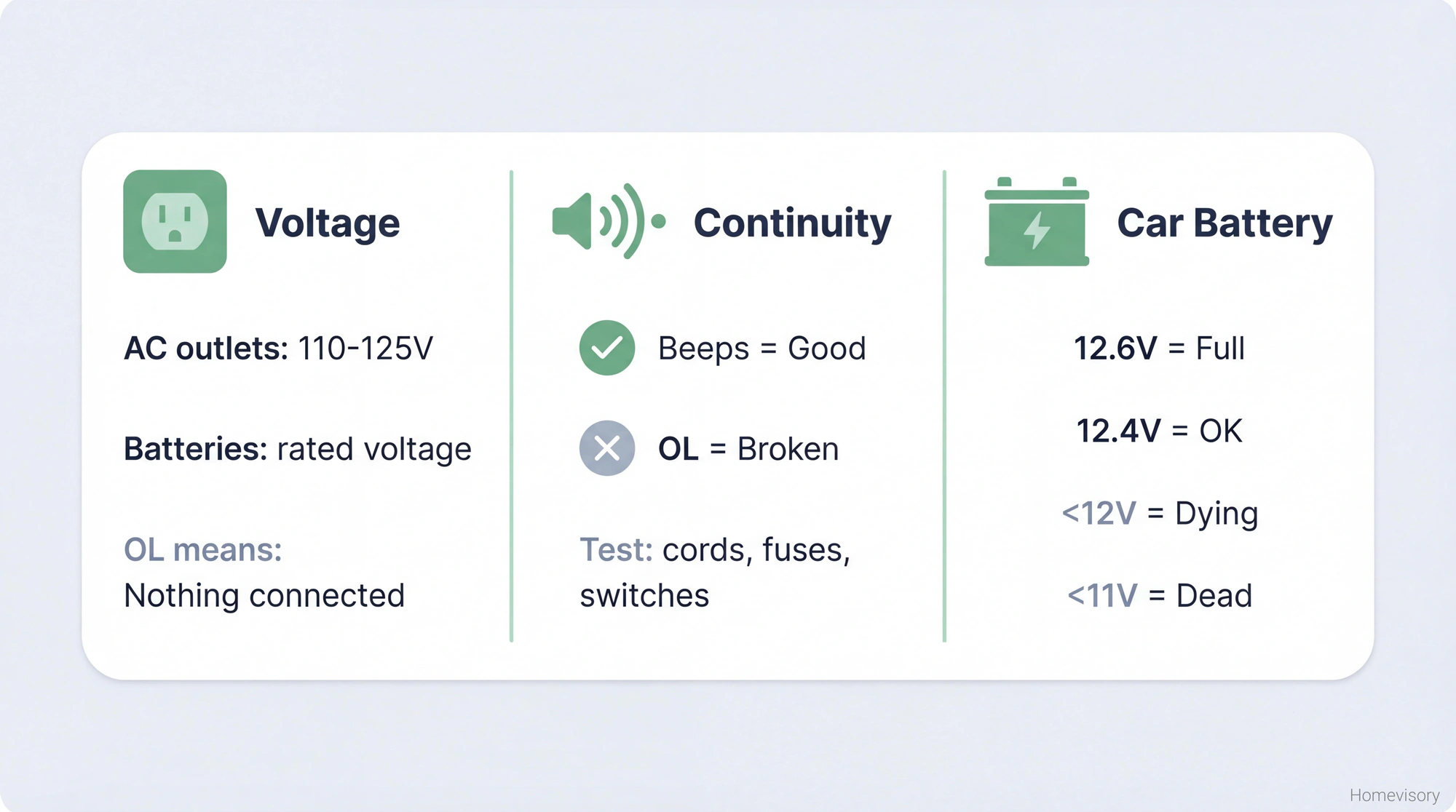
For AC voltage, you’ll see around 120. For DC, you’ll see whatever the source is rated for. For a car battery, 12.6 volts is fully charged, 12.4 is okay, below 12 means its dying, below 11 means its dead.
Keep the probes clean. Replace the batteries in the meter when the screen gets dim. Dont test things youre not sure about.
What You Should Actually Test
Outlets when something plugged in isnt working. Batteries before you blame the device. Extension cords when they’re acting weird. Fuses in your car or your house. Light switches that seem intermittent. The heating element when your dryer stops heating. The thermostat sensor when your oven temperature seems wrong. Christmas lights to find the one dead bulb thats killing the whole string, though honestly good luck with that, the continuity test works but finding which bulb it is takes forever.
A multimeter wont fix anything. It just tells you what the problem is so you know what to fix. That alone is worth $30 and an afternoon learning how to use it.
Homevisory tracks stuff like this. Electrical maintenance, HVAC checks, all the things you forget until something stops working. You can set it up to remind you to test your smoke detector batteries or check your GFCI outlets or whatever else needs regular attention. Its free, and it keeps everything in one place so you’re not trying to remember when you last did something. Thats what we do here at Homevisory.