The Real Numbers on Level 2 Charger Installation
Everyone wants to know what it costs to install an EV charger at home before they commit to anything. I get it. Youre about to buy a $45,000 car and suddenly realize you need to figure out charging, and the dealership guy was no help, and now youre googling at 11 PM trying to understand the difference between Level 1 and Level 2 and whether your house can even handle this.
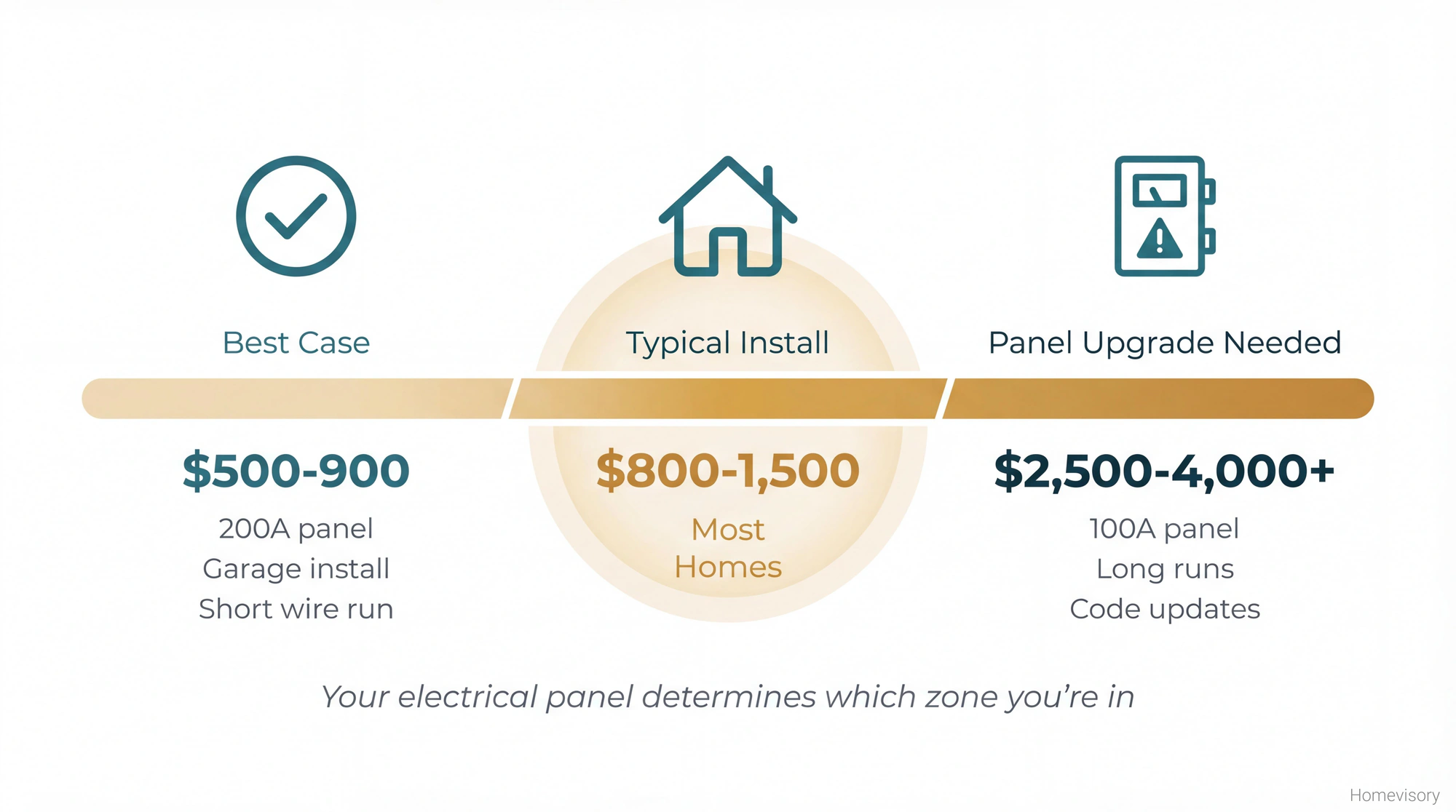
I’ve helped probably two dozen people figure out their Tesla charger installation cost over the past few years. Neighbors, church friends, my buddy Marcus who called me panicking three days after he picked up his Model Y. The short answer for a Level 2 charger installation cost in 2026 is somewhere between $500 and $2,500 for most homes. The long answer is more complicated and depends almost entirely on your electrical panel situation.
Thats what this article is about. The real costs. Not the “starting at $299” nonsense you see in ads.
The Charger Itself
The hardware is the easy part. A Tesla Wall Connector runs about $475 direct from Tesla. The ChargePoint Home Flex is around $550. Grizzl-E, which I’ve installed for a couple people and its a solid unit, is closer to $400. There are cheaper options in the $250-350 range but I’m not going to recommend those because the build quality is questionable and you’re mounting this thing in your garage for the next decade.
I’m not getting into the Tesla vs ChargePoint vs Grizzl-E thing here. Different article. For this one just budget $400-600 for a quality Level 2 charger and move on.
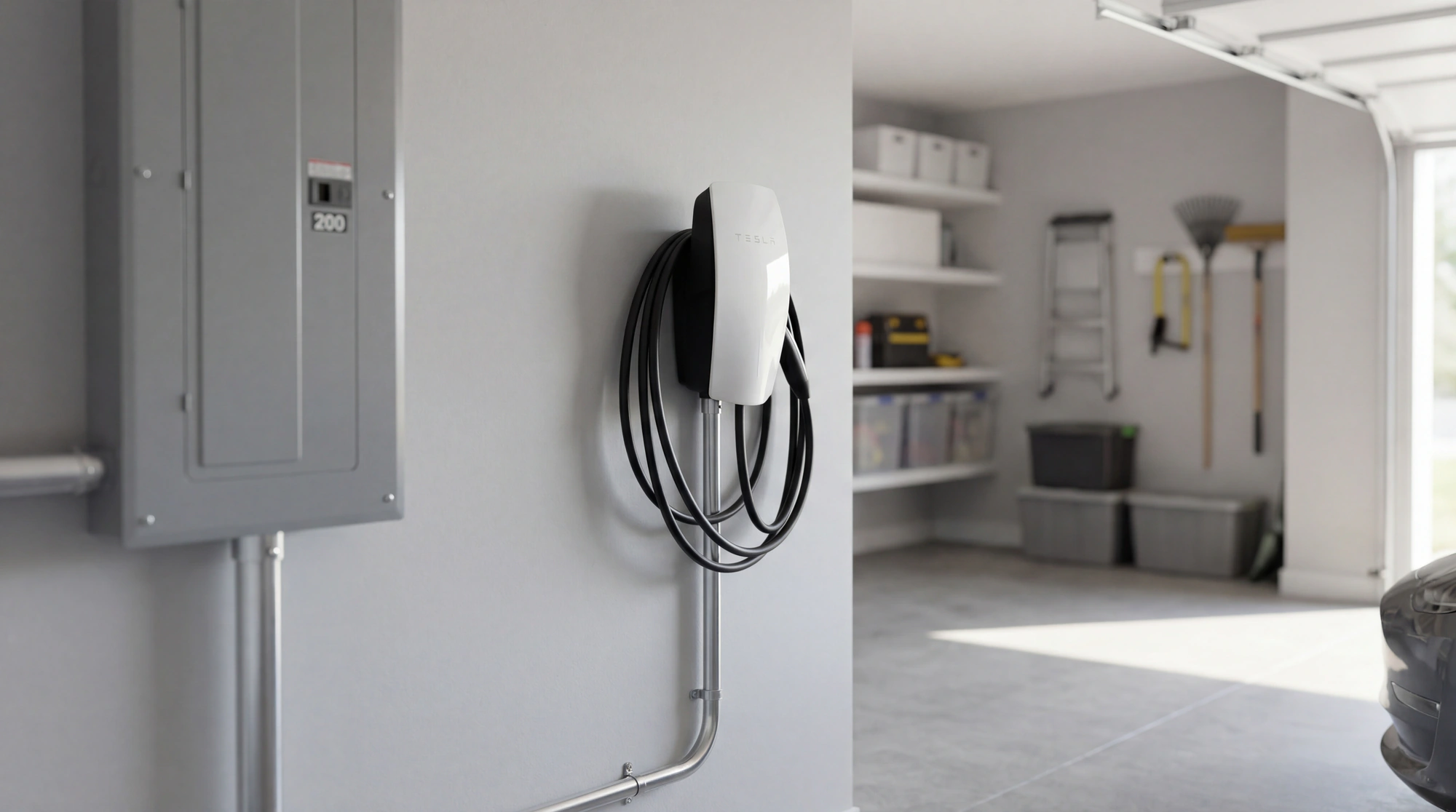
If you already have a Tesla, the Wall Connector makes sense because it matches, it looks clean, and it integrates with your car’s app. Tesla wall connector installation is also well-documented online so if something goes wrong you can actually find answers.
The Installation Labor
This is where quotes start varying wildly. An electrician will charge you somewhere between $300 and $800 for labor depending on where you live and how complicated your setup is. I’ve seen quotes in Palm Beach range from $400 to $1,200 for what should be the same job. One guy wanted $1,800 and I told my neighbor to hang up the phone.
The labor cost depends on a few things. How far is your panel from where the charger will go. Is there a clear path to run the wire or does it have to go through finished walls. Is the panel in the garage or in some closet on the other side of the house. These questions matter.
A straightforward install, panel in the garage, charger ten feet away on the same wall, no drywall to patch, you’re looking at maybe three hours of work. Call it $400-500 in labor. Tesla home charger installation cost starts looking reasonable at that point.
But most installs aren’t straightforward.
The Electrical Panel Problem
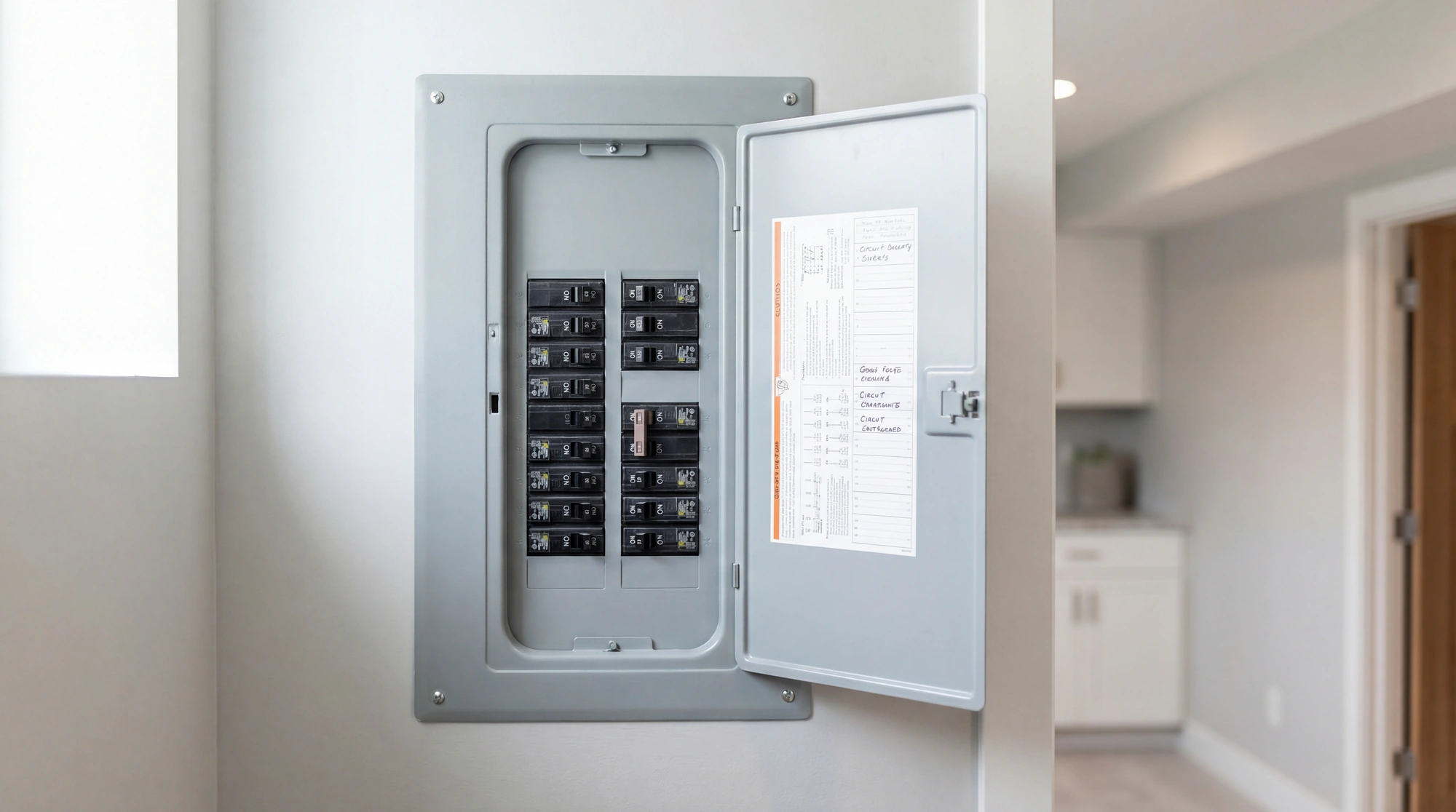
This is where I’m going to spend some time because this is where most people get surprised and not in a good way. Your electrical panel has a capacity measured in amps. Most older homes have 100-amp panels. Newer homes usually have 200-amp panels. A Level 2 charger needs a 50-amp circuit — basically a 240-volt outlet — though some can run on 40 or even 30 amps if you configure them for slower charging.
Heres the thing. Even if you have a 200-amp panel, that doesn’t mean you have 50 amps to spare. Your HVAC is using 30-40 amps. Your electric dryer is using 30 amps. Your oven, your water heater if its electric, your pool pump if you have one in Florida like everyone does, all of that adds up. An electrician has to do a load calculation to figure out if you actually have room for a 50-amp circuit.
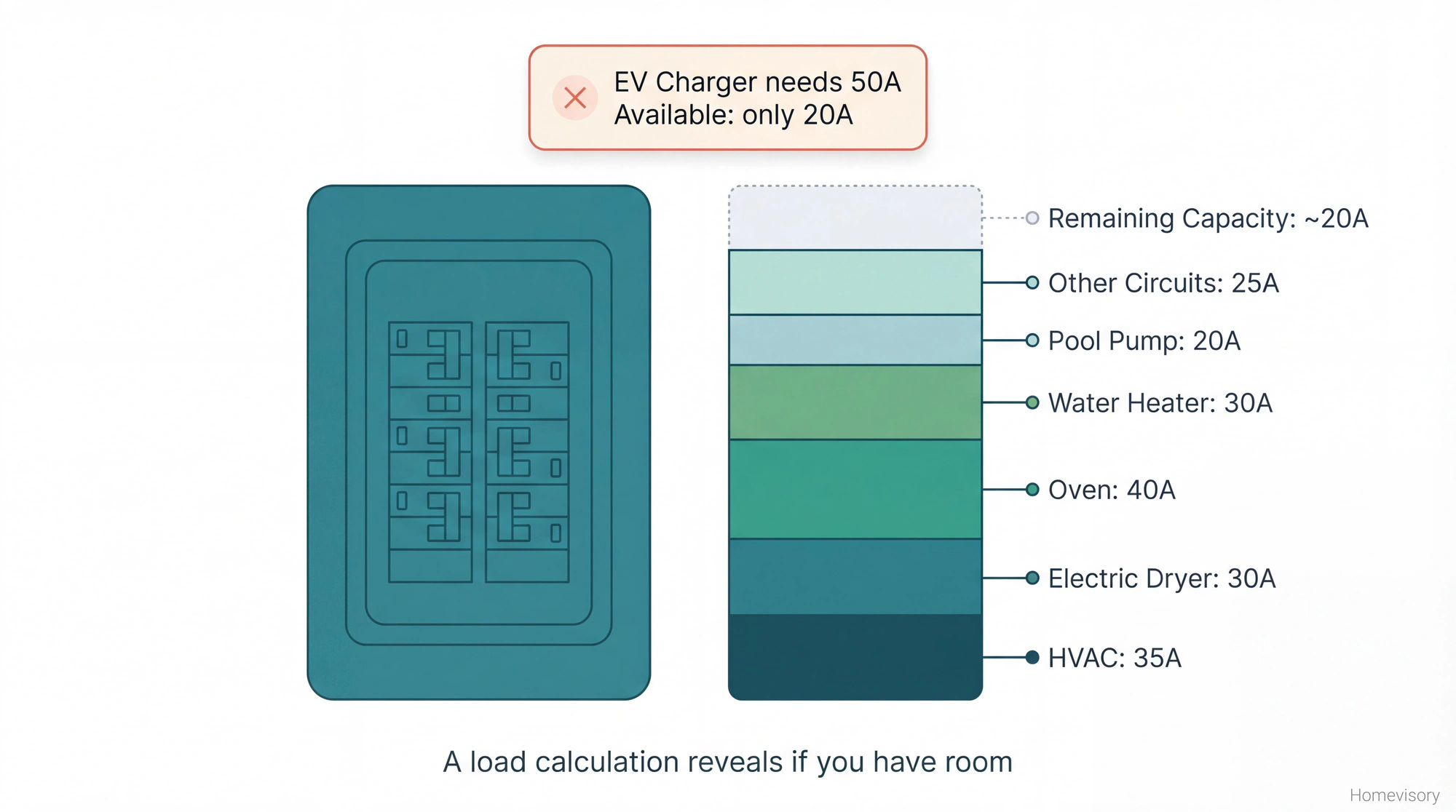
If you don’t have room, you have two options. You can upgrade your panel, which is expensive. Or you can install a load management system that shares capacity between circuits. The second option is cheaper but adds complexity.
A panel upgrade from 100 to 200 amps costs between $1,500 and $4,000 depending on your utility company’s requirements and whether the upgrade triggers other code compliance issues. In some jurisdictions they make you bring your whole electrical system up to current code when you touch the panel, which can add thousands more. I watched a guy in Plano spend $6,000 on what he thought would be an $800 charger install because his panel was from 1987 and once they opened it up everything snowballed. The original wiring was aluminum, the grounding wasn’t right, the utility had to send someone out to upgrade the connection from the street, it was a mess. His Tesla charger installation cost ended up being more than he spent on a year of gas before he went electric.
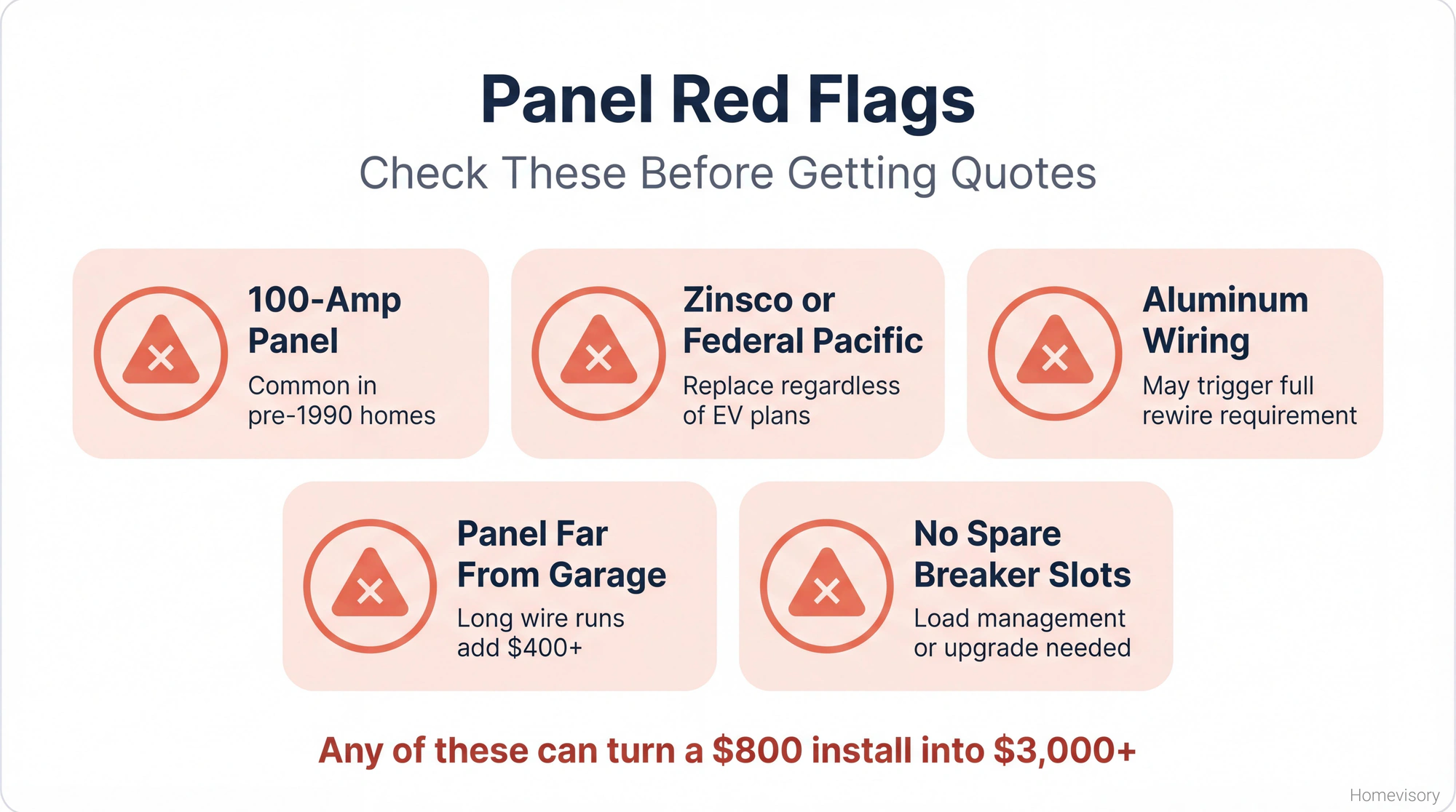
My buddy Dave, lives two streets over, he bought a Model 3 last spring and called me because the first electrician quoted him $3,800 and he wanted to know if that was normal. I went over and looked at his panel. 100 amps, nearly maxed out because he’s got a pool, an electric dryer, and central AC that’s oversized for his house. The electrician wasn’t ripping him off. That was a legitimate quote because Dave needed a panel upgrade plus the actual charger install. We ended up finding a different electrician who could do it for $2,900 but it was still way more than Dave expected. The cost to install EV charger at home is not $500 when your panel situation is a mess.
If you have a 200-amp panel with room to spare, and the panel is in the garage, and you don’t need to run wire through finished walls, the cost to install level 2 charger at home can genuinely be in the $600-900 range including labor and materials. That’s the best case scenario. Most people aren’t in that situation.
Permits and Inspections
Some cities require a permit for EV charger installations. Some don’t. Some require an inspection. Some just want you to file paperwork. The permit cost ranges from $50 to $200 in most places.
Call your city. Prices vary. Moving on.
Actually no, one more thing. Don’t skip the permit if its required. If you ever sell your house and the buyer’s inspector notices an unpermitted electrical installation, you’ll have problems. Its not worth saving $100 to create a headache later.
Materials Beyond the Charger
The charger is $400-600. Labor is $400-800 for a basic install. But there’s also wire, conduit, a circuit breaker, and mounting hardware.
A 50-amp circuit breaker is around $15-40 depending on your panel brand. Some panels require specific breakers that cost more. If you have a Zinsco or Federal Pacific panel from the 1970s or 80s, first of all get that thing replaced regardless of the EV charger situation, but also the breakers are either discontinued or dangerously defective. If your circuit breaker keeps tripping even without the charger, get the panel inspected before adding any load to it.
The wire is where costs can climb. You need 6-gauge wire for a 50-amp circuit. If the run is short, under 30 feet, you’re looking at maybe $100-150 in wire. If the run is long, say your panel is inside the house and your charger is on the detached garage 80 feet away, the wire alone could cost $400-600. Copper isn’t cheap and it keeps getting more expensive.
Conduit, junction boxes, mounting brackets, maybe $50-100 depending on the run.
My dad Curtis used to say, about factory work, he’d say “know your materials before you commit to a schedule.” He was talking about production deadlines but it applies to home projects too. Know what materials you need before you agree to a price. A good electrician will spec this out for you. A bad one will quote low and hit you with change orders.
Getting Quotes
Get three quotes minimum. I know thats annoying because scheduling electricians in 2026 is like trying to get a restaurant reservation on Valentine’s Day. Everyone is installing solar panels and EV chargers and heat pumps and the good electricians are booked out six weeks. The bad electricians are available tomorrow. Ask yourself why.
When you get quotes, make sure they’re itemized. I want to see labor, materials, permit fee, and any panel work broken out separately. If someone gives you a single number with no breakdown, push back or move on.
Also verify they’re licensed. In Florida you can check this on the DBPR website in about thirty seconds. Every state has something similar. Don’t let someone unlicensed do electrical work in your house. It’s not worth the risk and your homeowners insurance may not cover problems if the work was unpermitted or done by someone unlicensed.
Tesla-Specific Considerations
Tesla wall charger installation has a couple quirks. The Wall Connector can be hardwired or plugged in. If you go with a plug, you need a NEMA 14-50 outlet instead of hardwiring directly to the charger. Some people prefer this because if you move, you can take the charger with you and leave the outlet for the next owner. Others prefer hardwiring because it’s cleaner and eliminates one potential point of failure.
The cost difference is minimal. An outlet is maybe $30 and takes an extra fifteen minutes to install.
Tesla also offers installation through their website where they connect you with a certified installer. The prices are competitive, usually $750-1,500 for the installation depending on complexity. The convenience is nice because they handle the coordination. The downside is you don’t always get the same electrician twice if something goes wrong.
How much to install Tesla charger at home through their program versus finding your own electrician is usually comparable. The Tesla installers aren’t cheaper. They’re just convenient.
Real Numbers From Real Installs
Let me give you some actual examples from people I know.
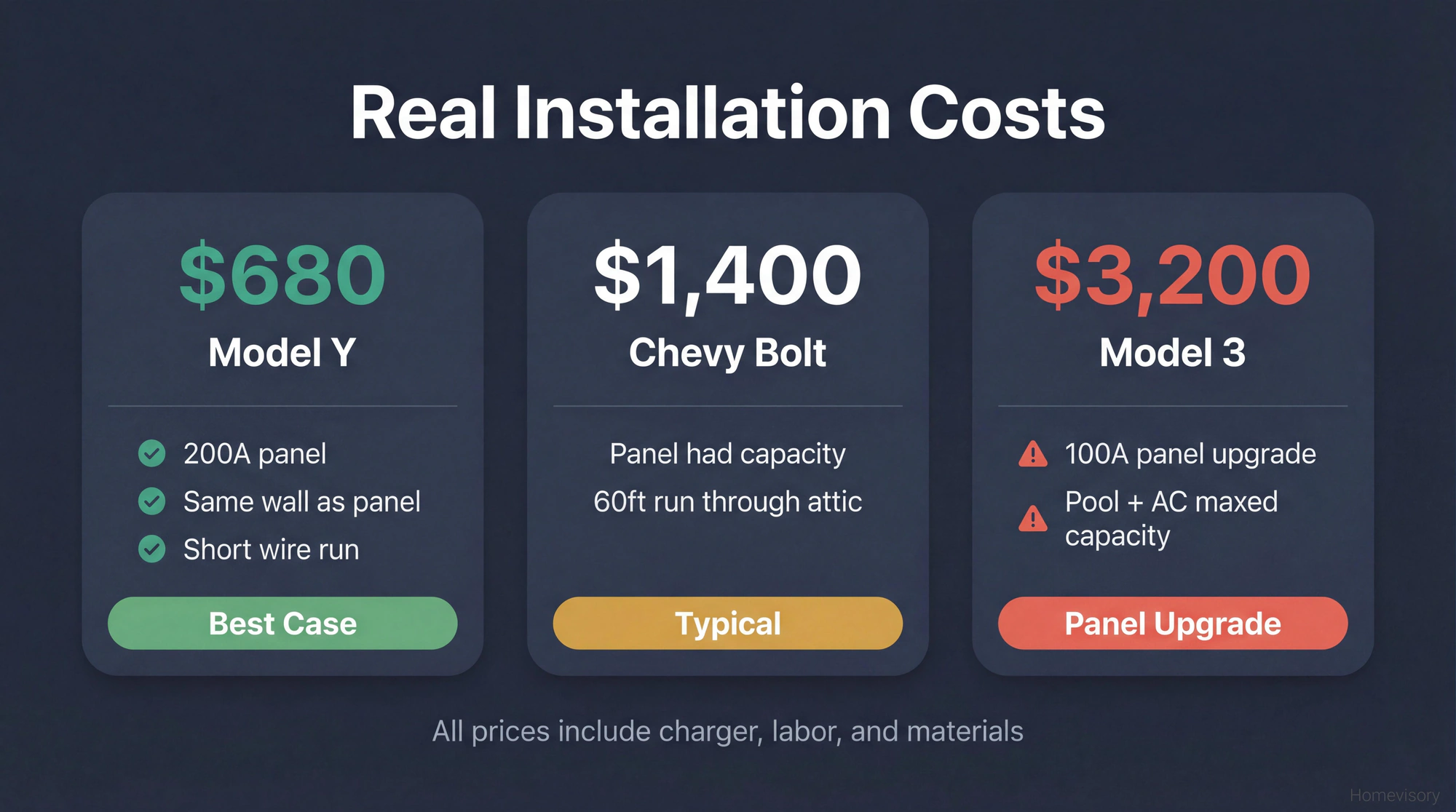
My neighbor Dave. Model 3. Panel upgrade required. Total cost to install level 2 charger: $3,200 including the charger.
Marcus from church. Model Y. 200-amp panel with space. Charger on same wall as panel. Total home EV charger installation cost: $680 including the charger.
A guy Raquel works with. Chevy Bolt. Panel had room but charger location was 60 feet from the panel through the attic. Total ev charger installation cost: $1,400 including charger.
When we moved to Palm Beach I looked into getting a charger installed because Raquel was thinking about going electric. We have a 200-amp panel and the garage is right there but something came up, I don’t remember if it was the quote or the timing or if we just got distracted with something else. Anyway.
The range is real. Somewhere between $600 on the low end and $4,000+ on the high end. The level 2 charger installation cost depends almost entirely on your electrical situation and how far the wire has to run.
What You Can Do Yourself
Not the electrical work. Don’t do the electrical work yourself unless you’re a licensed electrician. But you can do a few things to bring costs down.
Mount the charger yourself if you’re comfortable with basic tools. Some electricians will charge extra for mounting. If you pre-mount it or at least pre-drill the holes, you save time on their clock.
Run the conduit yourself if it’s surface-mounted in your garage. This is probably two hours of work if you know what you’re doing. The electrician can come in, pull the wire, make the connections, and leave. Less labor time means lower cost.
Buy your own charger instead of getting it through the electrician. Some will mark it up. Others don’t care. If you buy direct from Tesla or Amazon you know exactly what you’re paying.
The Bottom Line
For a Tesla charger installation cost or any electric vehicle charger installation, budget $800-1,500 for an average install. That covers the charger, labor, materials, and permit. If you know you have panel issues or a long wire run, budget $2,500-4,000.
The best thing you can do is have an electrician look at your panel before you commit to anything. Most will do this for free or for a small trip charge. They can tell you within fifteen minutes if you have capacity and give you a ballpark number before they even write up a formal quote.
Mr. Davis, my old woodshop teacher, used to say the foundation matters more than the finish. Your electrical panel is the foundation here. Get that figured out first. Everything else follows.